Summary:
High in the Garhwal Himalayas, deodar forests retain substantial amounts of carbon in large, long-lived trees. Farther downslope, species-rich mixed forests perform a different role, storing more carbon in the soil.
Researchers compared deodar forests at 1,900–2,300 metres, pine forests at 1,550–1,950 metres and mixed forests at 500–1,000 metres. Deodar stands recorded the highest tree biomass carbon density, ranging from 230.85 to 274.85 megagrams per hectare. Pine forests, dominated by a single tree species, contained substantially less.
The pattern shifted below ground. Mixed forests, which supported 28 tree species, had the largest active and passive soil carbon pools and the highest concentrations of both easily decomposed and more persistent carbon in the upper soil.
Published in Carbon Research, the study suggests that different forest types provide complementary carbon benefits. Protecting mature deodar stands could preserve major biomass stocks, while conserving and expanding diverse mixed forests could strengthen soil carbon storage. Greater species diversity may also improve the carbon-sequestration capacity of pine forests.

— Press Release —
Himalayan forests: A dual strategy for carbon capture
Increasing atmospheric carbon dioxide (CO₂) levels pose a significant global challenge, making the assessment of natural carbon sinks, such as forests, ever more critical. New research conducted in the Garhwal region of the Indian Himalayas investigates how different forest types contribute to carbon storage across varying altitudes. The investigation by Arvind Singh, Vinod Prasad Khanduri, and colleagues identifies distinct carbon partitioning strategies, where high-altitude conifer forests excel at storing carbon in biomass, while lower-elevation mixed broadleaf forests are superior in stabilizing soil carbon. This understanding is vital for developing effective climate mitigation plans.
Unpacking Himalayan carbon dynamics
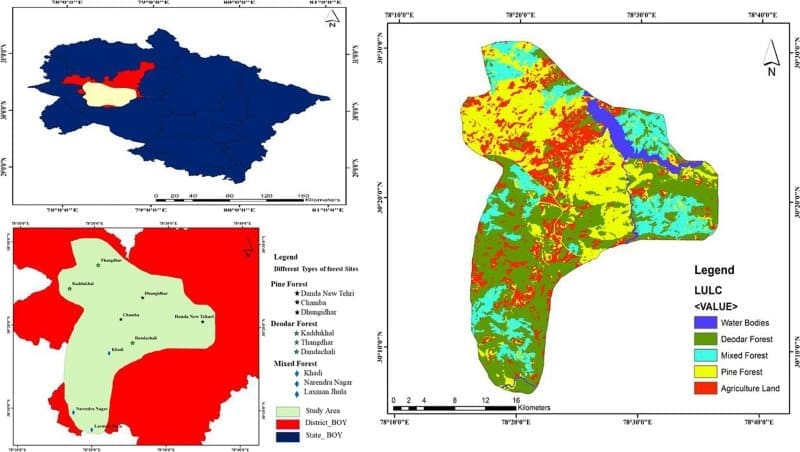
To understand these dynamics, scientists evaluated three distinct forest types: Deodar (1,900–2,300 m), Pine (1,550–1,950 m), and Mixed Forests (500–1,000 m). The team meticulously analyzed tree biomass carbon density (TCD) and soil organic carbon (SOC) pools at two depths (0–15 cm and 15–30 cm). This comprehensive field-based comparative study across a significant elevation gradient provides a process-oriented assessment of how carbon is allocated within these crucial ecosystems.
The findings indicate that Deodar Forests, characterized by large, long-lived conifers such as Cedrus deodara, exhibit the highest tree biomass carbon density (230.85–274.85 Mg ha⁻¹). These forests, typically found at higher altitudes, function as important long-term biomass carbon reservoirs. In contrast, Pine Forests, often dominated by Pinus roxburghii, showed lower biomass carbon density, although they still contribute to regional carbon sequestration.
Crucially, Mixed Forests, which are rich in broadleaf species and located at lower elevations, demonstrate superior soil organic carbon storage. These diverse forests show the highest levels of very labile carbon (7.43 mg g⁻¹) and non-labile carbon (2.06 mg g⁻¹) in their topsoil, alongside the largest active (13.48 t C ha⁻¹) and passive (6.41 t C ha⁻¹) carbon pools. This suggests that mixed forests are particularly effective at converting organic inputs into stable, long-term soil carbon forms.
Tailored strategies for climate resilience
The observed divergence in carbon storage patterns – with biomass carbon peaking at higher altitudes and soil carbon stabilization dominating at lower elevations – carries significant implications for climate mitigation strategies. These results suggest that effective forest management in the Himalayas requires altitude-specific approaches. Conserving existing old-growth Deodar Forests is essential for maintaining significant biomass carbon stocks, while promoting mixed-species reforestation and protecting existing mixed broadleaf systems can enhance soil organic carbon sequestration.
While the study offers robust insights, the authors note that disentangling the precise effects of forest type versus elevation-related microclimatic situations remains a complex challenge. Future investigations could benefit from expanded temporal monitoring to capture seasonal and interannual variations, microbial community analyses to understand decomposition processes, and the development of species-specific allometric equations for improved biomass estimation. Such research would further refine our understanding of these intricate ecosystems.
Read also: How fungi help store carbon in soil for millennia
Integrating these ecological insights into forest management plans is critical for strengthening India’s carbon sink potential and meeting climate commitments, aligning with the National Mission for Sustaining Himalayan Ecosystem (NMSHE) and UN Sustainable Development Goal 15. A dual strategy that combines the preservation of high-biomass coniferous forests with the expansion of biodiversity-rich mixed broadleaf plantations offers a powerful pathway toward enhanced carbon storage and greater climate resilience in the vulnerable Himalayan region.
Suggested author quote for approval: “Our research underscores that a ‘one-size-fits-all’ approach to forest carbon management in the Himalayas is not effective. Instead, recognizing the complementary roles of coniferous forests in biomass retention and mixed broadleaf forests in soil carbon stabilization allows us to develop targeted, altitude-specific strategies that optimize carbon sequestration and enhance ecosystem resilience against climate change.”
Journal Reference:
Singh, A., Khanduri, V.P., Rawat, D. et al., ‘Himalayan altitude gradient drives divergent carbon storage: conifer biomass peaks, broadleaf soils stabilize’, Carbon Research 5, 48 (2026). DOI: 10.1007/s44246-026-00287-z
Article Source:
Press Release/Material by Biochar Editorial Office | Shenyang Agricultural University (SYAU)
Featured image credit: Vishrut Panday via Wikimedia Commons | CC BY-SA