Summary:
Climate neutrality plans from 103 European cities expect emissions to remain in 2030 after planned reductions, with carbon removal intended to compensate for roughly a fifth of overall emissions. The study estimates these residual emissions at 61.4 million tonnes of CO₂ equivalent, originating mainly from buildings and transport.
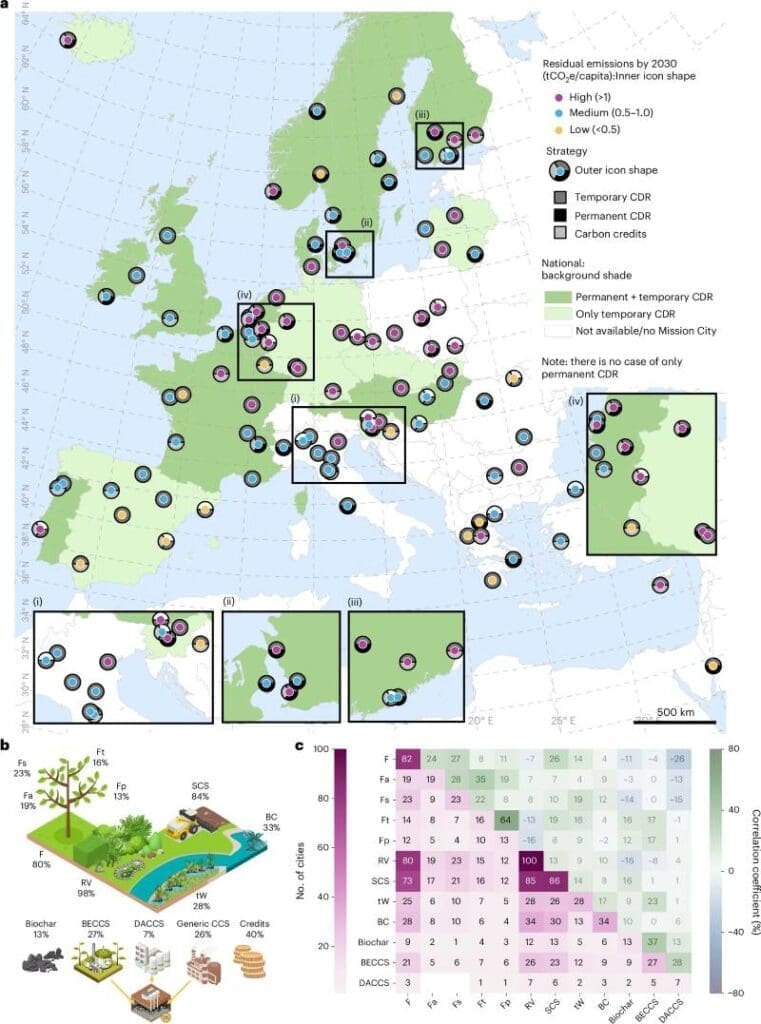
Researchers led by the European Commission’s Joint Research Centre (JRC) assessed how cities intend to manage those remaining emissions. Their analysis in Nature Climate Change found that all 103 strategies include temporary carbon removal based on land. Carbon credits feature in 40% of plans, while 32% mention permanent removal approaches, including bioenergy with carbon capture and storage (CCS), biochar and direct air capture and storage.
The assessment placed the robustness of current strategies in the medium-low range. Quantified estimates of carbon removal cover only 18% of total residual emissions, while plans give limited attention to land availability, monitoring, timing, quantification and safeguards against carbon reversals.
The authors recommend deeper emissions reductions first, so that residual emissions are confined to hard-to-abate sectors.
— Press Release —
European cities plan to compensate for a fifth of their emissions through carbon removal, few have thought through how
An analysis of 103 European cities’ 2030 climate neutral plans (including 22 capital cities) shows that municipalities are planning to rely on carbon removal to compensate for about a fifth of their emissions. This would mean removing roughly 61 million tonnes of emissions from the atmosphere – close to Austria’s annual emissions.
The study, published today in Nature Climate Change, led by the Joint Research Centre of the European Commission and contributed to by scientists at the Potsdam Institute for Climate Impact Research, reveals that the majority of cities’ residual emissions are in the energy and transport sectors (median at 50 and 31 percent respectively), despite both being considered easy-to-abate. The authors say this raises concerns about strategy effectiveness, urban constraints, and strict timelines, warning that the cost and speed of action may be prioritised over transformative change.
“These cities are pursuing extremely ambitious decarbonisation targets, which is to be applauded and should serve as an inspiration to others. But they are using vague criteria to determine where residual emissions will come from, and might have not given enough consideration to options that would eliminate these emissions in the first place,” commented PIK scientist and co-author of the study Quirina Rodriguez Mendez.
The study develops an index to measure the robustness of residual emission strategies – the RESRI index – which points to weaknesses when it comes to monitoring and quantifying how much carbon dioxide removal is available in cities and when. Current estimates for carbon removal capacity only covers 18 percent of total residual emissions.
“It’s really important that these removals actually happen and are transparently accounted for so that bad practice doesn’t reduce them to mere hot air,” Rodriguez Mendez said.
The study offers best practices and makes concrete suggestions for city policymakers to evolve from existing plans, including frontloading emissions reductions to concentrate residual emissions exclusively in hard-to-abate sectors. They also suggest implementing demand-side measures, which could reduce emissions by 40-80 percent, depending on the context.
Robust carbon removals matter
The study shows that the 103 cities analysed overwhelmingly rely on land-based carbon removals, such as tree planting, which raises concerns about permanence and land availability in urban environments, where competing needs for housing, health and energy restrict area available for green spaces. The study notes that current climate neutral plans do not include detailed land availability assessments.
Permanent carbon removal is less prevalent in cities’ plans, with only 32 percent mentioning it, through bioenergy carbon capture and storage (27 percent), biochar (13 percent) and direct air carbon capture and storage (7 percent). Carbon credits feature in 40 percent of plans but are often poorly specified, used as a last resort, and met with widespread distrust by cities themselves.
The study suggests that for climate neutrality to be achieved and maintained, cities may have to gradually complement temporary carbon dioxide removal with more permanent options. But this would require regulatory clarity, infrastructure development and predictable support, especially for permanent carbon removals; all of which would depend on national and even international governance bodies working together.
Journal Reference:
Ulpiani, G., Rodriguez Mendez, Q., Todeschi, V. et al., ‘Empirical insights into residual emissions in urban net-zero targets’, Nature Climate Change (2026). DOI: 10.1038/s41558-026-02691-0
Article Source:
Press Release/Material by Ulrich von Lampe | Potsdam Institute for Climate Impact Research (PIK)
Featured image credit: Eduardo Casajús Gorostiaga | Unsplash