Explore the latest insights from top science journals in the Muser Press roundup (September 25, 2026), featuring impactful research on climate change challenges.
In brief:
— Press Release —
Does livestock grazing enhance or hinder soil carbon storage?
Grassland plants transfer large amounts of carbon to soil through their roots, and most of that carbon is stored below ground. Therefore, promoting soil carbon storage can be important to help combat climate change. Grazers feed on grassland plants, and conventional wisdom often assumes that removing grazers benefits carbon storage, but a new study in Global Change Biology Communications reveals that the opposite may be the case.

Drawing on real-world evidence from long-term cessation of grazing in the sub-arctic grasslands in Iceland, researchers found that grazing abandonment resulted in lower soil carbon, while continued grazing consistently resulted in higher soil carbon. Long-time grazing abandonment also promoted ecological shifts to lower-soil carbon vegetation types.
“The findings have important implications for climate policy, nature-based solutions, and sustainable grassland management worldwide,” said corresponding author Anna Gudrun Thorhallsdottir, PhD, a professor at the University of Iceland at Holar. “They highlight the potential importance of grazing to sustain grasslands and enhance soil carbon storage.”
Journal Reference:
Christian Klopsch, Anna Gudrun Thorhallsdottir, Rene van der Wal, Richard D. Bardgett, Björn Thorsteinsson, Aslaug Geirsdottir, ‘Sustained Livestock Grazing Enhances Soil Organic Carbon Storage in Sub-Arctic Grassland’, Global Change Biology Communications 1, 4: e70049 (2026). DOI: 10.1002/gcb4.70049
Article Source:
Press Release/Material by Sara Henning-Stout | Wiley
— Press Release —
Past emissions from top polluters will continue warming the planet for decades to come
If someone leaves the faucet running in your bathroom and the house floods, it’s easy to assign responsibility for the damage. But for other disasters – bigger, more complicated and costlier ones – the link between cause and effect isn’t as clear.
In recent years, scientists have improved methods for connecting extreme weather events, sometimes called climate disasters, to climate change. Advancements in attribution science clarify how burning fossil fuels has increased the likelihood of extreme weather occurring. These findings form the backbone of a growing list of lawsuits attempting to hold major emitters responsible for deaths and damages incurred during climate disasters.
A new University of Washington study takes this work a step further by showing that past emissions from carbon majors – the top 178 oil, gas, coal and cement producers – will continue impacting our environment for decades to come.
The results were published in PLOS Climate.
“We know that fossil fuel emissions have caused a lot of warming, and we’re seeing the impacts of that, but the question is: How long does that warming last into the future?” said Dargan Frierson, a UW associate professor of atmospheric and climate science.

If greenhouse gas emissions were to plummet tomorrow, the environment would not revert back to its old self. Carbon majors have emitted more than a trillion tons of carbon dioxide, a substantial portion of which will remain in the air, trapping heat, for millenia.
Even if we stop emitting, Earth will remain approximately 1.5 degrees Celsius above preindustrial temperatures.
“We expect continued warming of the climate until we stop fossil fuel emissions,” Frierson said. “The only stable future is one with no fossil fuels burned at all.”
To arrive at this conclusion, researchers simulated global climate through 2500 using the Finite Amplitude Impulse Response, or FaIR, model in both low and higher emissions scenarios, with and without emissions from carbon majors through 2024.
In a future where greenhouse gas emissions are limited, carbon majors are responsible for a larger percent of warming above preindustrial levels.
In higher emissions scenarios, where fossil fuel burning continues unabated, Earth becomes much warmer as emissions rise. In the most extreme scenario tested, future emissions cause a much larger percentage of warming than carbon majors. But the total temperature change from carbon majors is about the same.
“The amount of warming is calculable and relatively independent of future emissions,” Frierson said. “If there are legal decisions about accountability, the responsibility is not just now, it will continue for many many years into the future.”
The relationship between greenhouse gases and global warming is not new. In fact, scientists understood the risks many decades ago. Efforts to hold emitters accountable hinge on allegations that companies knew about those risks and concealed that information from the public, sometimes employing deceptive tactics to spread disinformation.
This new study shows that the gasses released by leading emitters, from both extracting and burning fossil fuels, may also be responsible for events that have not happened yet. Emissions from the past can increase the odds of a future disaster through persistent warming.
“This is important for current decisions about fossil fuels,” Frierson said. “Future fossil fuel production will exacerbate climate disasters for many decades to come, so new legal battles about who is accountable should be expected for many years.”
Lauren Henrie, a former student of Environmental Science and Resource Management at the UW, is a co-author.
Journal Reference:
Frierson DMW, Henrie LA, ‘Centuries of global heating from Carbon Majors: Dependence on future emissions pathways’, PLOS Climate 5, 9: e0001036 (2026). DOI: 10.1371/journal.pclm.0001036
Article Source:
Press Release/Material by Gillian Dohrn | University of Washington (UW)
— Press Release —
Hurricane Helene deposited nearly one-fifth of annual microplastics at one North Carolina site
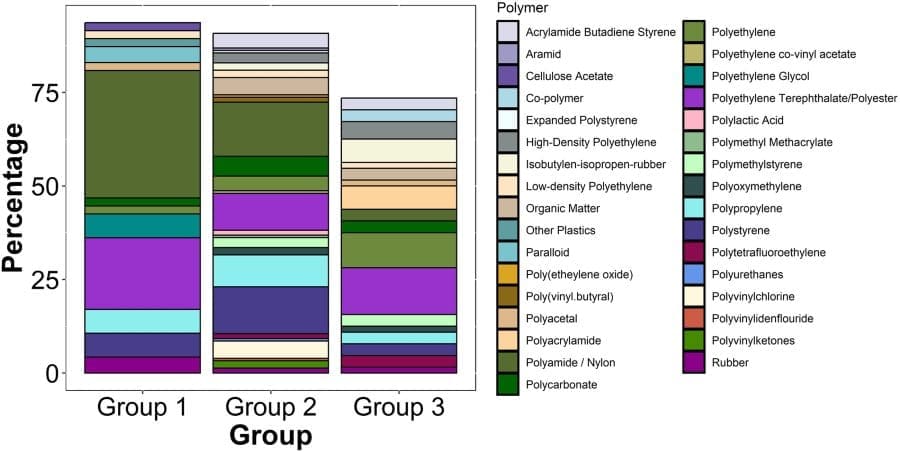
Rainfall from Hurricane Helene produced a short-term spike in microplastics at three sites in Western North Carolina, with microplastic deposition three to 22 times higher than before the storm.
The storm accounted for 18.8 percent of the annual microplastic deposition at Highlands Biological Station at Western Carolina University, 4.2 percent at Iron Duff in Haywood County, and 4.6 percent at Coweeta Hydrologic Laboratory in Macon County.
“The microplastic footprint Helene left behind was pretty substantial,” said Austin Gray, a Virginia Tech biologist. “Microplastics are depositing all over terrestrial and aquatic areas, especially after a storm event, and that changes what we consider an impacted zone since the particles deposited could have originated from areas far away.”
This was the first U.S.-based study to assess microplastic deposition before, during, and after a hurricane. The research – conducted by team from Virginia Tech, Western Carolina University, Highlands Biological Station, and the University of North Carolina – was published recently in Integrated Environmental Assessment and Management.
Pre-storm
Before Helene, researchers were measuring microplastics in the headwaters of the Richland Creek Watershed and the Cullasaja River Basin. They wanted to know how many microplastic particles were transported through the streams – and how much is floating around in the atmosphere and deposited in these remote locations by rain or wind.
To answer these questions, they measured microplastic accumulation at three different locations, distinguishing between particles that settled in dry periods and those that settled in rainy periods.
The samplers were actively collecting through the storm that struck the southern Appalachian Mountains on Sept. 25, 2024, bringing 20 to 30 inches of rain and causing catastrophic flooding.
The findings show that during Hurricane Helene, microplastic deposition was three to 22 times higher than before the storm.
Post-storm
Data collection continued in the weeks after the storm, offering new insights into how microplastics circulate through the environment and the effects of a major storm and its aftermath.
Microplastics are usually associated with urban watersheds near roads and development. The headwaters targeted in this study are rural, forested, and generally seen as pristine or less impacted by microplastic pollution.
“There’s been very little investigation into microplastics within small headwaters, particularly low-order stream networks, but these small streams account for more than 70 percent of the total stream length in the continental U.S.,” Gray said. “And if it’s happening in the headwaters, then it’s going to flow downstream.”
But how are microplastics getting into headwaters? A recent study in Nature estimated that more than 600 quadrillion microplastic particles are in the atmosphere – that’s 600 followed by 15 zeros. Working with Virginia Tech’s Hosein Foroutan in civil engineering, Gray and his collaborators estimated that the storm released 385 quadrillion additional microplastic particles into the atmosphere above normal levels.
After Helene, the researchers also saw an uptick in microplastics deposited on dry days.
“We speculate that it was because microplastics deposited by the storm stuck to the surface of the leaves. Later, wind may have blown those particles back off the leaves, causing more microplastics to be deposited on subsequent dry days,” said Nathaniel Barrett, a Virginia Tech graduate student in biological sciences who works in Gray’s Aquatic Toxicology and Ecology Lab. “That’s something that we’re trying to investigate in future research.”
Other outstanding questions include the full extent of the storm’s microplastic footprint, what risks microplastics pose to human health and biodiversity, and how to better track the movement of microplastics through the environment.
“This is just one study,” Gray said. “And it’s the only one of its kind conducted in the United States. But imagine what this looks like as we confront storm events of growing intensity and frequency with coordinated sampling efforts and funding support to better understand these dynamics. This is something that could be even more impactful in the Southeast, where there’s a lot of vulnerable biodiversity.”
***
Additional researchers include: Jason Love, Western Carolina University; James Campbell, Western Carolina University; Jerry Miller, Western Carolina University; Radmila Petric, University of North Carolina at Chapel Hill; Robert Youker, Western Carolina University; Xinyue Huang, Virginia Tech.
Journal Reference:
Austin Gray, Jason Love, Nathaniel Barrett, James Campbell, Jerry Miller, Radmila Petric, Robert Youker, Xinyue Huang, Hosein Foroutan, ‘Influence of Hurricane Helene on microplastic deposition in the mountainous southeastern United States’, Integrated Environmental Assessment and Management online ver., vjag130 (2026). DOI: 10.1093/inteam/vjag130
Article Source:
Press Release/Material by Kelly Izlar | Virginia Tech (VT)
— Press Release —
Remote sensing mitigated the impact of the 2025 Los Angeles wildfires
The January 2025 Los Angeles wildfires, fueled by prolonged drought and extreme Santa Ana winds, rapidly spread across the region, destroying thousands of structures, causing widespread evacuations and fatalities, and becoming one of the most destructive and costly wildfire disasters in California’s history.
Rolla et al. (2026) highlight how satellite and airborne observations provided by NASA supported situational awareness throughout the disaster, even as the Eaton Fire forced the temporary closure of the Jet Propulsion Laboratory. These observations also proved essential for damage assessment, air quality monitoring, infrastructure evaluation, and debris-flow forecasting.

By examining both the value of these remote sensing products and the operational challenges encountered during the Los Angeles wildfires, the study identifies priorities for improving wildfire risk mitigation. It further concludes that upcoming missions, including the NASA-ISRO Synthetic Aperture Radar (NISAR) and Surface Biology and Geology (SBG) missions, will further enhance the ability to transform Earth observations into actionable information for disaster response and management.
Journal Reference:
Rolla, J., Miner, K., Elder, C., Howard, E., Milton, J., & Spangler, N., ‘Remote sensing during the 2025 Los Angeles wildfires’, AGU Advances 7, 5: e2025AV002092 (2026). DOI: 10.1029/2025AV002092
Article Source:
Press Release/Material by Alberto Montanari | EOS
Featured image credit: Magnific (AI Gen.)