The study, published in Science Advances, was conducted by researchers from the Danish Meteorological Institute (DMI) and the Swedish Meteorological and Hydrological Institute (SMHI). It examines whether severe AMOC weakening represents an irreversible climate tipping point, particularly when freshwater from Greenland’s melting ice sheet continues entering the North Atlantic.
AMOC carries warm surface waters northward through the Atlantic and returns colder water southward at depth, influencing temperatures, precipitation and sea levels across the North Atlantic region and beyond. Rising temperatures and freshwater input can weaken this circulation by reducing the density of surface waters and suppressing the formation of deep water.
Scientists have investigated whether this weakening could eventually trigger a self-sustaining transition to a much weaker circulation, making recovery difficult even if the conditions responsible for the decline were reversed.

Testing the limits of Atlantic circulation
Led by climate researcher Chuncheng Guo, the team used the EC-Earth3-ESM-1 Earth system model, which incorporates changes in Greenland’s ice sheet alongside interactions between the atmosphere, ocean and sea ice.
Unlike many climate models that exclude changes in Greenland’s ice mass, this system calculates ice loss and freshwater discharge as the climate evolves, allowing their combined effects on ocean circulation to be investigated.
Read also: Weaker Atlantic circulation could increase ocean heat storage
The researchers tested idealized carbon dioxide emissions pathways involving progressive warming, periods of zero carbon dioxide emissions and subsequent cooling driven by net carbon dioxide removal. These experiments explored a wide range of temperature increases, including extreme warming beyond typical projections for this century, rather than predicting conditions for specific dates.
As global temperatures increased, AMOC weakened progressively. At approximately 7 °C of warming above preindustrial levels, its simulated strength declined from around 17 million to 6 million cubic metres of water transported per second.
At higher warming levels, the circulation weakened further, crossing thresholds that some studies use to define collapse. Yet these very weak states did not represent irreversible tipping in this model. When temperatures declined, AMOC regained strength despite continued freshwater entering the ocean from Greenland.
Recovery closely followed the cooling, although the process could take centuries after extreme warming. The researchers also found that the locations supporting deep-water formation changed as temperatures increased.
Deep mixing became strongly suppressed in the Labrador and Irminger Seas, while some winter mixing persisted in the Nordic Seas. Additional mixing developed farther north as Arctic sea ice retreated, helping maintain a weakened circulation and supporting its recovery.
The researchers identified this redistribution of deep-water formation as an important factor in AMOC’s resilience, although the relative contributions of the interacting ocean processes remain incompletely understood. Even when circulation strength recovered, the distribution of deep-water formation differed from its original state, indicating that the wider North Atlantic system did not necessarily return to its previous conditions.
Greenland ice loss follows a different path
Greenland’s ice sheet showed a substantially different response. Ice loss accelerated with warming and continued during periods of relatively stable temperatures. Subsequent cooling slowed the decline but did not restore the ice already lost.
In the simulations, warming to 1.5 °C before temperatures returned to preindustrial levels left Greenland with ice losses equivalent to approximately 20 centimetres of global mean sea-level rise. After warming to 6 °C, the corresponding contribution from Greenland’s ice sheet reached approximately 3.5 metres.
Read also: Earth’s heat buildup accelerates as global warming reaches 1.37 °C
These figures represent Greenland’s contribution to global mean sea-level rise from accumulated ice loss under hypothetical warming and cooling scenarios, not projections of total global sea levels by particular dates.
Important uncertainties remain. The research relies on a single climate model, and longer periods under relatively stable conditions could reveal instabilities not captured by the experiments. Other climate models may respond differently, particularly in how they simulate deep-water formation and changes in ocean circulation.
The cooling experiments also required carbon dioxide removal rates considerably higher than those considered feasible under realistic climate mitigation scenarios. Additional tests using reduced removal rates produced similar AMOC recovery, but whether this behaviour would persist under much slower, achievable cooling remains unresolved.
The results therefore cannot establish that irreversible AMOC tipping is impossible in the real climate system. Nor would eventual recovery eliminate the consequences of prolonged weakening, which could affect regional temperatures, precipitation and sea levels over centuries.
The distinction between severe weakening and irreversible tipping is central to the research. A circulation system that recovers under falling temperatures can still undergo changes with lasting consequences, while Greenland’s ice sheet may retain much of the loss accumulated during earlier warming. Together, these responses show why the possibility of reversing some climate changes does not remove the risks associated with allowing them to develop.
Journal Reference:
Chuncheng Guo, Shuting Yang, Ilana Schiller-Weiss, Jorge Bernales, Steffen M. Olsen, Torben Koenigk, Rashed Mahmood, Tian Tian, and Klaus Wyser, ‘Reversible Atlantic overturning despite continued Greenland ice sheet melt’, Science Advances 12, 42: eaee5373 (2026). DOI: 10.1126/sciadv.aee5373
Article Source:
Press Release/Material by Danish Meteorological Institute (DMI)
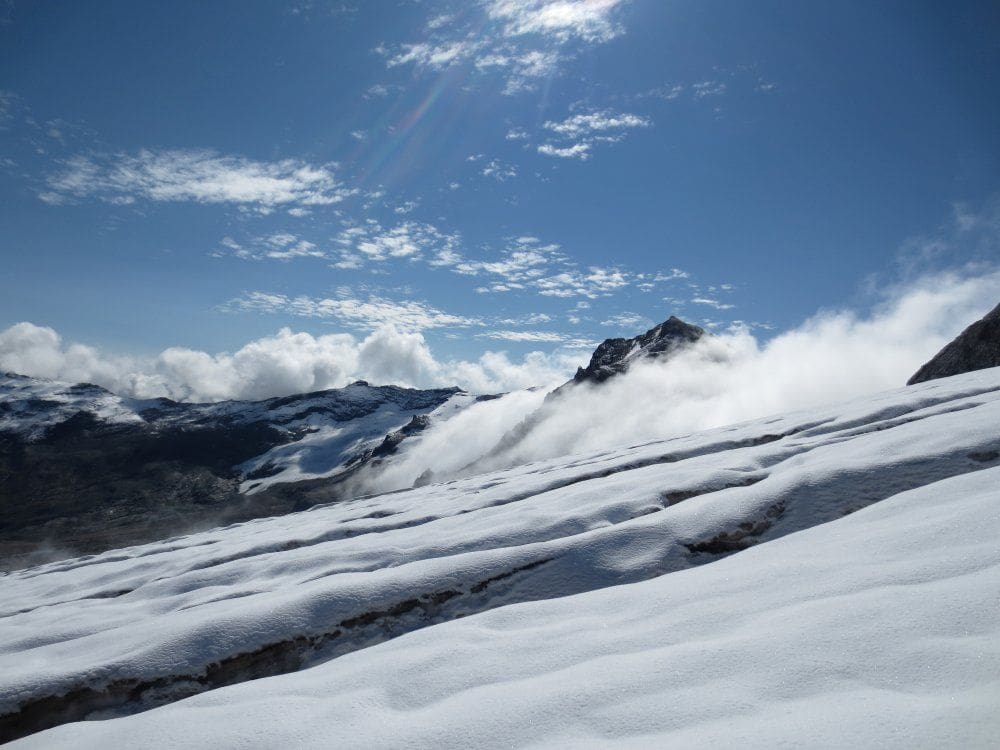
Featured image: Glaciers flowing into Johan Petersen Fjord in southeastern Greenland, photographed during NASA’s Operation IceBridge mission in September 2016. Credit: Jeremy Harbeck | NASA Goddard