Summary:
Climate policy could substantially change the economic interests of countries worldwide, creating different incentives to support or resist emissions reductions. A study by the Potsdam Institute for Climate Impact Research (PIK), published in Nature Sustainability, examines how these differences could shape international cooperation across 169 countries.
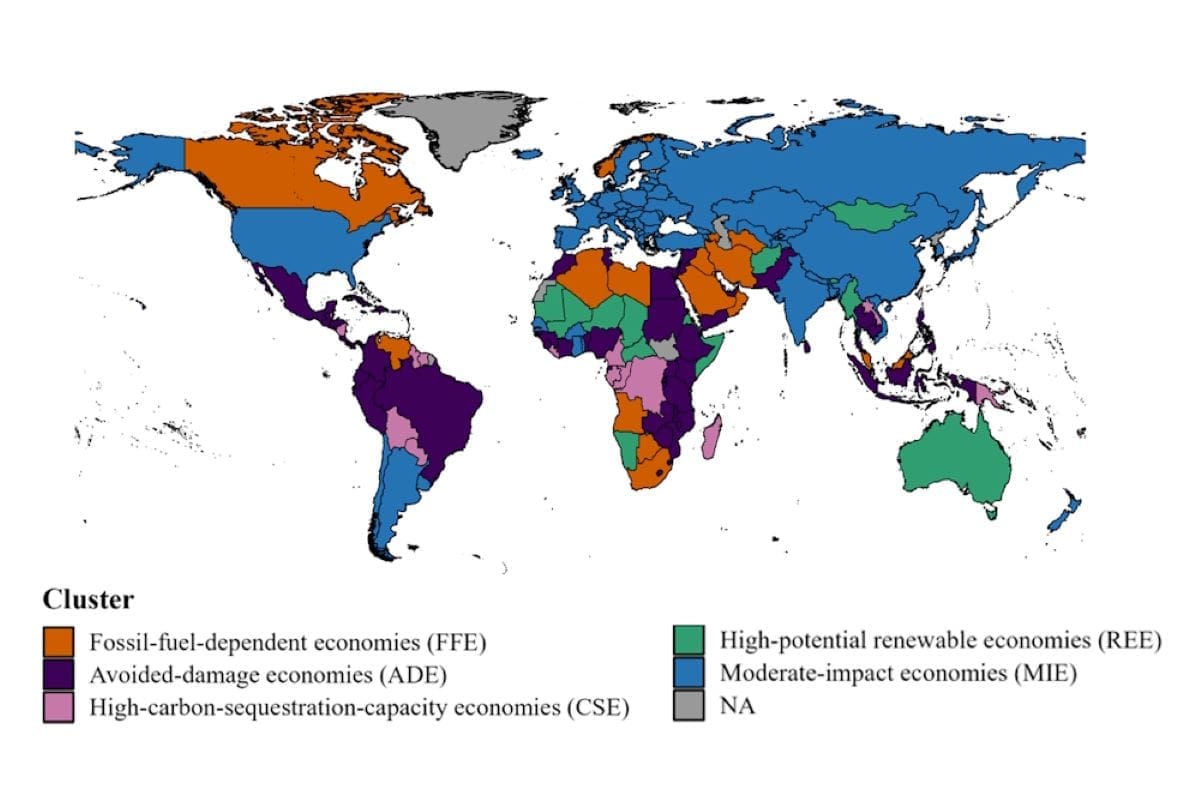
Researchers assessed four factors: potential losses from declining fossil fuel demand, avoided climate damages, renewable energy potential and land carbon storage capacity. Their analysis identified five groups of countries with different economic interests in the transition to a low-carbon economy.
Nineteen fossil fuel-dependent countries, representing just 6% of global economic output, face substantial potential losses. Meanwhile, 51 countries could benefit particularly from avoided climate damages, 13 have significant renewable energy potential, many in Africa, and 17 possess substantial carbon storage capacity.
The remaining 69 economies, including the United States, China and the European Union, account for 81% of global economic output but show comparatively moderate impacts within the study’s framework.
The researchers suggest that climate cooperation could be strengthened through agreements combining emissions reductions with trade incentives, research and development partnerships or financial support for countries facing economic disadvantages.
— Press Release —
A world map of climate policy: Who stands to gain most?
A study by the Potsdam Institute for Climate Impact Research (PIK) published in Nature Sustainability now shows, for 169 countries around the world, how the fight against global heating affects national assets – and what geopolitical challenges and opportunities arise as a result.
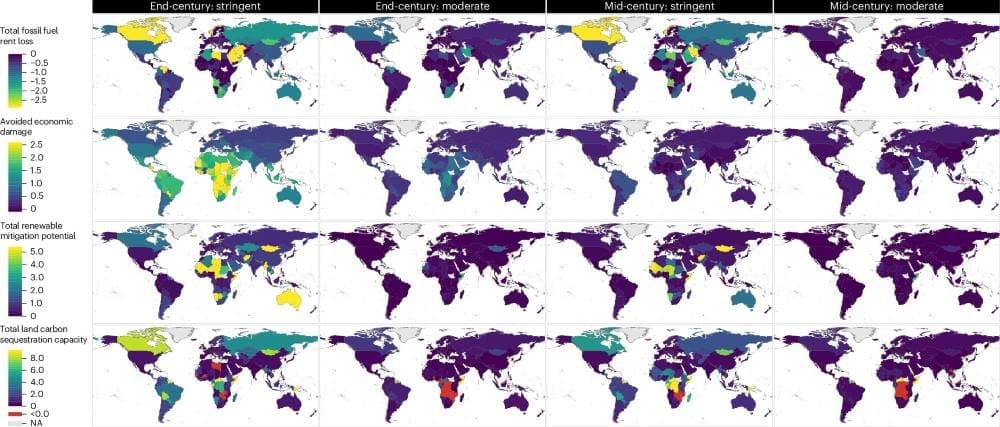
The unprecedentedly comprehensive dataset compiled by the research team shows how climate policy affects national assets in four ways:
- it reduces demand of fossil fuels, potentially leading to losses in oil, gas and coal revenues;
- it reduces climate-related damage to the national economy;
- it creates new economic opportunities for solar and wind energy development; and
- it increases the value of a country’s capacity to absorb and store CO₂ from the atmosphere – whether “naturally” via forests or “managed” through the stewardship of natural areas.
“Based on our data analysis, we can map how countries could gain or lose from different aspects of decarbonisation by the end of this century, depending on the level of ambition in climate policy,” reports Guanna Pan, PIK researcher and lead author of the study. “We explore geopolitical tensions that may arise from some countries experiencing losses, but we also show how national interests can foster international cooperation, and how this can be further strengthened through targeted incentives.”
Five groups of countries with similar interests
To better understand potential economic gains and losses across countries, the research team has identified clusters – that is, groups of states in which climate policy generates similar economic opportunities and risks, and potentially shared interests. According to the study, 19 fossil fuel-dependent countries would potentially oppose ambitious measures.

By contrast, 51 countries in the Global South have a strong interest in a rapid climate transition as they would otherwise face particularly severe climate damages. Likewise, 13 countries “with high potential for renewable energy” – the majority of which are in Africa – and 17 countries “with high carbon sequestration capacity” would also naturally favour swift action in the fight against global heating.
However, these four clusters do not carry all that much political weight: the group of oil, gas and coal-dependent countries accounts for only 6 percent of global economic output, and the three groups of countries that especially stand to benefit from climate protection account for only 13 percent combined. The remaining 81 percent of economic output is accounted for by the fifth cluster – the 69 “economies with moderate impacts” – which includes the EU, China and the US. In this group of countries, the economic benefits of climate policy are, in absolute terms, considerable in many cases, particularly due to avoided climate damage. Calculated as a percentage, however, it is not as large as in the three clusters of strong winners.
Climate policy safeguards long-term prosperity
In summary, the research team notes that humanity as a whole must take a collective interest in climate action, but that the differences in gains and losses between countries need to be fully understood. The study provides the necessary guidance and concludes with the recommendation that, where interests diverge, climate cooperation should be strengthened through “package deals”. This means that concessions on climate protection for hesitant countries should be linked with promises regarding trade or research and development; it could also mean simply offsetting losses through financial transfers.
“In view of the current resurgence of opposition to a committed climate policy, it is important to recognise that climate policy does not merely devalue certain assets – namely those of fossil fuel suppliers,” emphasises Ottmar Edenhofer, PIK Director and one of the co-authors. “Our study also demonstrates quite precisely how new assets are simultaneously being built up. Overall, climate policy revalues the capital stock of economies in a new and sustainable way, thereby safeguarding long-term prosperity.”
Journal Reference:
Pan, G., Kornek, U., Gong, C., Bacca, E., Luderer, G., Edenhofer, O., ‘Quantifying assets for the geopolitics of climate change mitigation’, Nature Sustainability (2026). DOI: 10.1038/s41893-026-01971-z
Article Source:
Press Release/Material by Potsdam Institute for Climate Impact Research (PIK)
Featured image credit: Pan et al. (2026) | CC BY