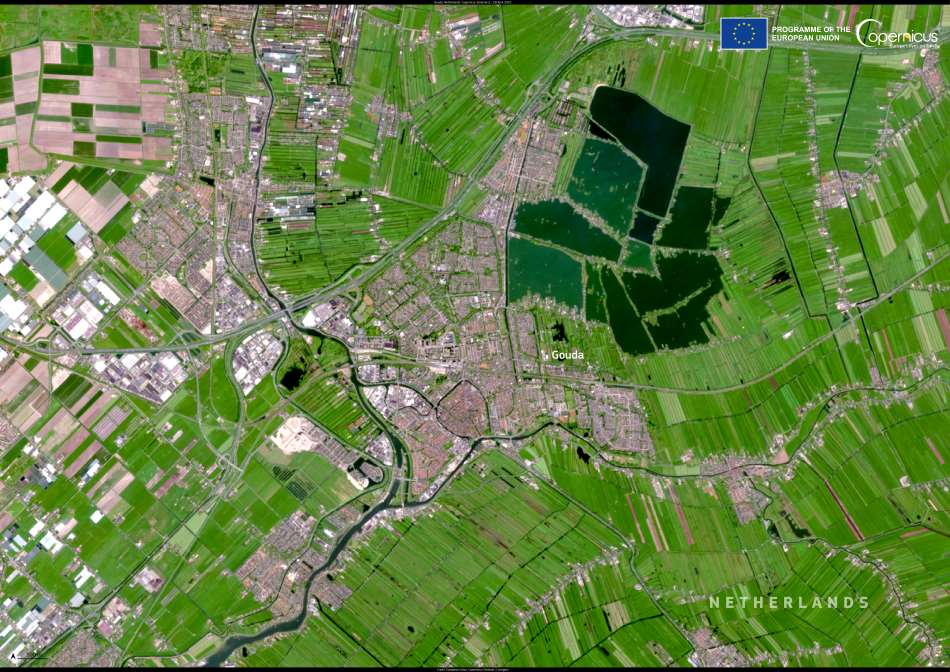
From above, the city of Gouda appears as a neatly patterned quilt of green fields, narrow canals, and red-tiled rooftops, a landscape shaped by centuries of water management and agricultural tradition. Captured on 29 April 2025 by the Copernicus Sentinel-2 satellite, this image offers a clear view of Gouda’s surrounding lowlands, which have long supported one of the country’s most iconic exports: cheese.
Gouda’s connection to cheese stretches back to 1540, when the city began hosting a weekly cheese market that brought dairy farmers and merchants together in its central square. Over time, the name Gouda became inseparable from the wheels of golden-hued cheese traded there, even though the cheeses themselves were, and still are, made in the surrounding countryside, not in the city proper. Today, Gouda cheese is known around the globe, with its mild flavor and creamy texture tracing their origins to the wet pastures of South Holland.
While Gouda’s traditions endure, they are increasingly at risk. Much of the city lies below sea level, relying on a complex system of dikes and pumping stations to keep floodwaters at bay. Rising sea levels and more frequent extreme weather events, fueled by climate change, are placing additional stress on these systems. Iconic regional products like Gouda cheese could face existential threats as climate conditions shift, affecting everything from pasture quality to animal health and milk yields.
In this context, satellite-based Earth observation is becoming a vital tool for farmers and regional planners. The Copernicus Sentinel-2 mission, part of the European Union’s Earth observation programme, provides high-resolution imagery that supports a range of land monitoring applications. For pasture management in dairy-rich regions like Gouda’s hinterland, this includes tracking vegetation health, identifying changes in plant growth, and measuring grazing pressure over time. Such data enables more effective rotational grazing and helps safeguard forage availability, even in the face of unpredictable weather.
The interplay between traditional farming and modern technology is particularly evident in the Netherlands, a country that has long relied on innovation to thrive in challenging environments. With over a quarter of its land below sea level, the Dutch have become pioneers in climate resilience, blending ancient water control systems with state-of-the-art environmental monitoring. Gouda is no exception, balancing heritage and adaptation as it navigates an uncertain future.
In the center of the Copernicus image, the city itself forms a dense cluster surrounded by waterways and farmland. The signature Dutch polder landscape, flat fields crisscrossed by canals, extends outward in every direction, a testament to centuries of reclamation and careful stewardship. The same landscape that nourished the dairy trade now presents both beauty and vulnerability.
While Gouda’s name will likely remain synonymous with cheese for years to come, its future depends increasingly on climate-aware land use and sustainable practices. The combination of heritage, satellite science, and agricultural innovation will determine whether this renowned region can continue producing the cheeses that have defined it for nearly 500 years.
As Earth observation continues to evolve, platforms like Copernicus not only offer a window into the past and present, but also serve as tools for anticipating what lies ahead – for Gouda and countless other places shaped by both tradition and environmental change.
Featured image credit: European Union, Copernicus Sentinel-2 imagery