The UN carbon market has approved the first issuance of carbon credits under the Paris Agreement, marking the start of operations for a mechanism designed to help countries cooperate on cutting emissions while supporting projects on the ground.
The initial credits come from a clean-cooking project in Myanmar that distributes efficient cookstoves to households. The stoves are intended to reduce harmful indoor air pollution and ease pressure on local forests by lowering demand for fuelwood. More than two billion people worldwide still lack access to clean cooking, and exposure to smoke from traditional stoves contributes to millions of deaths each year.
UN Climate Change Executive Secretary Simon Stiell said the project illustrates the broader purpose of the mechanism. “Over two billion people globally are without access to clean cooking, which kills millions every year. Clean cooking protects health, saves forests, cuts emissions and helps empowers women and girls, who are typically hardest hit by household air pollution.
“The first credits to be issued through the UN carbon market under the Paris Agreement come from a clean-cooking project, and they show how this mechanism can support solutions that make a big difference in people’s daily lives, as well as channeling finance to where it delivers real-life benefits on the ground. The opportunities presented by this UN carbon market across all regions are vast, particularly now that strong environmental safeguards, robust standards, and a clear system for redress are in place to ensure integrity, inclusiveness and efficiency.”
Cooperation under Article 6.4
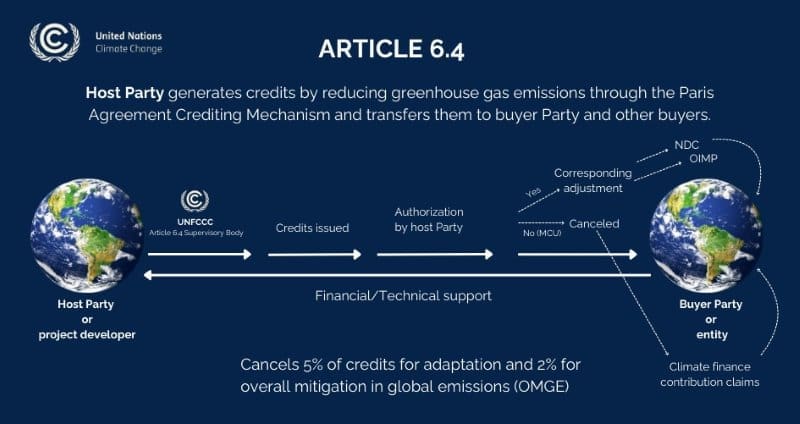
The project is coordinated with authorized participants from the Republic of Korea. Under the agreed arrangements, credits authorized for use in Korea can be transferred to Korean entities and counted within the Korean Emissions Trading System, contributing to the country’s Nationally Determined Contribution (NDC). The remaining credits will be applied by Myanmar toward its own NDC, reflecting the cooperative structure set out under Article 6 of the Paris Agreement.
The Paris Agreement Crediting Mechanism (PACM), also known as Article 6.4, was established to help countries raise climate ambition and implement national action plans more affordably. It enables the identification of verifiable emission reductions, attracts funding to implement them, and provides a framework for cooperation among countries and other actors. A Supervisory Body oversees the mechanism, including the approval of methodologies, registration of activities, accreditation of verification bodies and management of the Article 6.4 Registry.
Stricter calculations than previous systems
The issuance also signals a shift from earlier carbon market frameworks to the updated rules adopted by countries under the Paris Agreement. The clean-cooking activity had previously received a provisional issuance under the Clean Development Mechanism, the crediting system established under the Kyoto Protocol. Under the new mechanism, updated values and more conservative calculations are applied to determine the volume of emission reductions that can be credited.
Article 6.4 Supervisory Body Chair Mkhuthazi Steleki said the adjustments were deliberate. “This initial issuance reflects the careful application of the rules set by countries under the Paris Agreement. By applying updated values and more conservative calculations, the credited reductions are about 40 percent lower than what older systems would have issued. The result is consistent with environmental integrity requirements and ensures that each credited tonne genuinely represents a tonne reduced and contributes to the goals of the Paris Agreement.”
According to UN Climate Change, the revised approach results in credited reductions that are roughly 40 percent lower than those that would have been granted under the CDM. The aim is to ensure that each issued credit more closely reflects real-world emission reductions in light of current science and data, while recognizing investments made under earlier systems.
Article 6.4 Supervisory Body Vice Chair Jacqui Ruesga said beginning with a clean-cooking activity was significant both for climate and community impacts. “Starting with a clean-cooking project is a fitting demonstration of where the demand and impact are what the Paris Agreement Crediting Mechanism can do: support activities that bring clear co-benefits for people, such as better indoor air quality, while reducing emissions,” Ruesga said.
“Last year we requested the use of an updated methodological approach, which means the credits issued are aligned with the best available information and a careful calculation of the reductions achieved. Our focus is on building confidence in this market from the outset, and this first issuance shows that the system is working as intended.”
Appeal period and project pipeline
The approval remains subject to a 14-day appeal period, during which project participants, the host country and stakeholders directly affected may submit an appeal.
Beyond this first issuance, more than 165 host-Party-approved projects are in the pipeline to transition from the Clean Development Mechanism into the Paris Agreement Crediting Mechanism. These activities span sectors including waste management, energy, industry and agriculture, suggesting that a broader range of mitigation projects across regions may soon follow as the UN carbon market moves further into operation.
Article Source:
Press Release/Material by UNFCCC
Featured image credit: 8photo | Freepik