Explore the latest insights from top science journals in the Muser Press roundup (March 10, 2026), featuring impactful research on climate change challenges.
In brief:
— Press Release —
Genetic mapping of Baltic Sea herring important for sustainable fishing
Spring- and autumn-spawning herring in the Baltic Sea as well as in the Atlantic Ocean are genetically distinct. This is well known.

“Despite their striking genetic differences, we were able to identify hybrids between the spring- and autumn-spawning populations, thanks to the very large sample size in our present study,” says Leif Andersson, Professor at the Department of Medical Biochemistry and Microbiology at Uppsala University, who led the study together with Professor Linda Laikre, Department of Zoology, Stockholm University.
In other words, there are herring that, when they end up in a population spawning at the ‘wrong’ time of year, have been able to adapt their behaviour and spawn at the same time as the other herring in the surrounding population.
“Our interpretation is that genetics sets an optimal window for spawning, primarily spring or autumn, but water temperature and nutritional status influence when spawning happens. This would imply that there is a communication within the school, possibly due to hormones that set the spawning time for the school,” explains Andersson.
The Baltic herring are not only split into spring- and autumn-spawning populations. Thanks to this new study, the researchers discovered that the spring-spawning herring, which are widely distributed in the Baltic Sea, are further subdivided into a Northern, Central and Southern cluster. There are also additional groupings within the major clusters of spring-spawning herring. Linda Laikre points to a striking example from the Stockholm archipelago, the so called ‘wild rose herring’.
“We noticed that the genetic constitution of this population was more extreme than the populations from the Southern cluster. The explanation was that these herring was spawning in mid-July when the water is much warmer than in the spring. A population like this with adaptation to spawning in warmer waters may harbour gene variants of critical importance for future adaptation to a warming sea,” Andersson says.
The locals call the fish ‘wild rose herring’ because it spawns when the wild roses are in bloom.
The researchers believe their results have very important implications for the management of Baltic herring.
“Our findings showing that herring are subdivided into different clusters and groups are of great importance for management, since herring along Sweden’s east coast are currently managed as two large populations, one in the Baltic Proper and one in the Gulf of Bothnia. The current management does not correspond to the genetic groupings we see,” says Lovisa Wennerström from the Swedish University of Agricultural Sciences.
“We would like to see a much more restrictive industrial fishing for fish meal production to reduce the risk that important local populations and the genetic diversity they harbour get lost. Further, our results will constitute a basis for the Swedish Agency for Marine and Water Management’s monitoring program that aims at tracking genetic changes over time in key species such as herring,” Laikre added.
Journal Reference:
J. Goodall, M.E. Pettersson, A. Andersson, I. Dahlin, N. Ryman, G. Ståhl, L. Wennerström, L. Andersson, & L. Laikre, ‘The population structure in the Baltic herring reflects natural selection and local adaptation’, Proceedings of the National Academy of Sciences U.S.A. 123, (11): e2526500123 (2026). DOI: 10.1073/pnas.2526500123
Article Source:
Press Release/Material by Stockholm University
— Press Release —
Shifting from biotic to abiotic drivers of urban microbial multifunctionality under drought and rehydration
Qin-Lin Chen’s group at Institute of Urban Environment, Chinese Academy of Sciences, Xiamen, conducted microcosm experiments using Zoysia japonica, a common urban turfgrass. The team simulated four drought intensities and recovery by rehydration. Integrating omics technologies and soil enzyme stoichiometry, they analyzed alteration in microbial communities and biochemical cycling associated with carbon, nitrogen, phosphorus, and sulfur to pinpoint the drivers of urban microbial multifunctionality.

The results, published in Science China Life Sciences, demonstrated that drought intensities reshaped the composition of bacteria and fungi across the rhizosphere and phyllosphere. Unexpectedly, drought enhanced microbial multifunctionality by significantly boosting 21 microbial functional potentials, including carbon fixation and denitrification. Upon rehydration, urban microbial multifunctionality largely returned to the control levels. However, legacy effects of extreme drought persisted in specific functions, notably phyllosphere organic nitrogen mineralization.
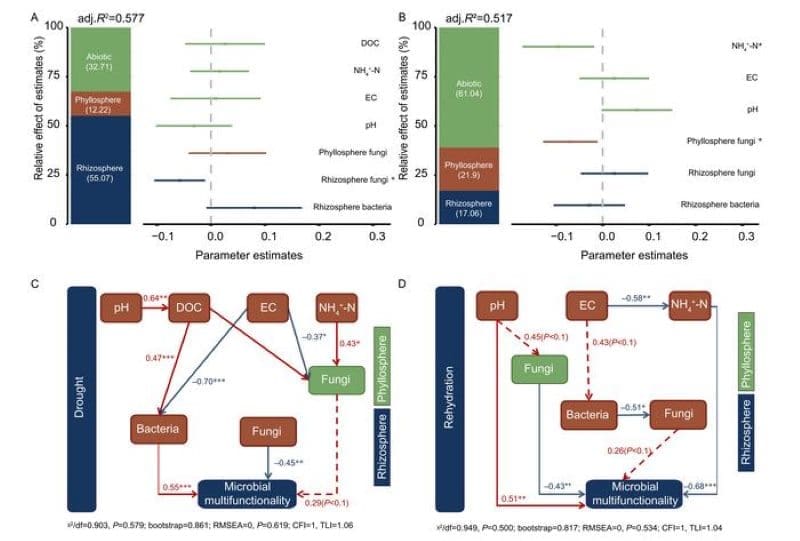
A key insight from the study was the distinct regime shift observed between drought and subsequent recovery. The analysis indicated that biotic factors, particularly rhizosphere bacteria and fungi, directly drove microbial multifunctionality during the drought phase. However, rehydration marked a transition. Soil physicochemical properties, specifically pH and ammonium nitrogen (NH₄+-N), emerged as the main direct drivers of stabilized ecosystem functions.
The study underscores a regulatory shift. Microbes defend ecosystem functions during drought shock, while soil properties dominant the recovery stages. Effective management requires a dual focus on biology and abiotic factors. Combining drought-resilient plants with precise management of soil physicochemical conditions is essential for rapid ecosystem recovery in urban environments.
Journal Reference:
Peng, C., Sun, A., Li, X. et al., ‘Shifting from biotic to abiotic drivers of urban microbial multifunctionality under drought and rehydration’, Science China Life Sciences 69, 970–982 (2026). DOI: 10.1007/s11427-025-3115-7
Article Source:
Press Release/Material by Science China Press
— Press Release —
Forest damage in Europe to rise by around 20% by 2100 even if warming is limited to 2 °C
Even in a scenario with warming limited to roughly 2 °C, annually disturbed forest area could rise from about 180,000 to roughly 216,000 hectares per year by the end of the century, compared to the already unprecedented levels of disturbances from 1986 to 2020. In a scenario in which fossil fuel use continues to increase, annually disturbed forest area could double, reaching nearly 370,000 hectares per year by the end of the century.

“In the future, Europe’s forests are likely to absorb less carbon,” says Christopher Reyer, scientist at PIK and co-author of the study. “If forests take up less carbon, or potentially even release more than they absorb, this increases pressure on other sectors such as transport and agriculture to reduce their emissions more rapidly. At the same time, forest management needs to focus more strongly on building resilient forests.”
According to the study, forests in Southern and Western Europe will be particularly affected and will undergo the strongest changes in forest disturbance. Northern Europe is expected to be less severely impacted overall, though hotspots of future forest damage are also likely to emerge there. The study was led by researchers at the Technical University of Munich (TUM).
Journal Reference:
Grünig, M., Rammer, W., Senf, C., Albrich, K., André, F., Augustynczik, A.L.D., Baumann, M., Bohn, F.J., Bouwman, M., Bugmann, H., Collalti, A., Cristal, I., Dalmonech, D., De Coligny, F., Dobor, L., Dollinger, C., Espelta, J.M., Forrester, D.I., Garcia-Gonzalo, J., González-Olabarria, J.R., Hiltner, U., Hlásny, T., Honkaniemi, J., Huber, N., Jonard, M., Jönsson, A.M., Kunstler, G., Lagergren, F., Lindner, M., Mina, M., Moos, C., Morin, X., Muys, B., Nabuurs, G.-J., Nieberg, M., Patacca, M., Peltoniemi, M., Reyer, C.P.O., Schelhaas, M.-J.; Storms, I., Thom, D., Toigo, M., Seidl, R., ‘Climate change will increase forest disturbances in Europe throughout the 21st century’, Science 391, (6789): eadx6329 (2026). DOI: 10.1126/science.adx6329
Article Source:
Press Release/Material by Potsdam Institute for Climate Impact Research (PIK)
— Press Release —
Turning orchard waste into climate solutions: A simple method boosts biochar carbon storage
Biochar is a carbon rich material produced when plant biomass is heated in low oxygen conditions. Because the carbon in biochar remains stable in soil for long periods, scientists consider it a promising carbon negative technology that can help remove carbon dioxide from the atmosphere. However, traditional biochar production typically requires specialized equipment and energy intensive processes, which limit large scale adoption.
In the new study, researchers explored a simple alternative inspired by natural burning processes. Instead of using industrial reactors, they combined open burning with a limewater treatment to improve carbon retention during the carbonization of orchard waste. The team tested this approach using pruned branches from Litchi trees, a common agricultural residue in southern China.
“Our goal was to develop a biochar production method that farmers could potentially use directly in orchards without expensive equipment,” said the study’s corresponding author. “By combining limewater treatment with a rapid water quenching process, we were able to significantly enhance carbon retention while maintaining a simple production method.”

The process works through a combination of chemical and physical mechanisms. Before burning, branches are immersed in limewater, allowing calcium compounds to penetrate and coat the biomass. When the branches are ignited, the outer layer burns quickly while the interior undergoes oxygen limited carbonization. The material is then rapidly quenched with water or limewater, preserving the carbonized structure and producing biochar.
The results showed that the limewater treatment dramatically improved performance. Biochar produced without treatment converted about 52 percent of the original biomass carbon into stable char. With limewater immersion and coating, the carbon conversion rate increased to approximately 86 percent.
The treated biochar also showed important improvements in structure and chemistry. It exhibited a much larger specific surface area and contained higher levels of oxygen containing functional groups, both of which are important for soil improvement and environmental applications. Microscopic and chemical analyses revealed that calcium compounds formed a protective barrier during combustion, helping prevent carbon from being oxidized into gases.
According to the researchers, the technique could have important implications for agricultural sustainability. Litchi orchards produce large amounts of pruned branches each year, which are often burned or discarded. Converting this biomass into biochar using the new method could turn a waste problem into a climate solution.
The study estimates that applying this strategy in Litchi orchards could sequester roughly 6,000 kilograms of carbon per hectare, equivalent to about 22,000 kilograms of carbon dioxide. This amount could potentially offset a substantial portion of the carbon emissions associated with orchard cultivation.
“This approach shows how agricultural waste can be transformed into a valuable resource,” the researchers noted. “Local production and local use of biochar could help farmers reduce emissions while improving soil health and supporting more sustainable agricultural systems.”
The researchers believe the simplicity and scalability of the technique make it particularly promising for rural and developing regions where access to advanced biochar production facilities may be limited. With further development, this method could contribute to broader efforts to reduce agricultural emissions and enhance carbon sequestration worldwide.
Journal Reference:
Xiao, L., Li, W., Wu, J. et al., ‘Enhanced carbon retention in Litchi biochar via in-situ limewater coating and self-limited oxygen pyrolysis regulated by water-fire interaction’, Biochar 8, 27 (2026). DOI: 10.1007/s42773-025-00514-7
Article Source:
Press Release/Material by Biochar Editorial Office | Shenyang Agricultural University (SYAU)
Featured image credit: Freepik (AI Gen.)