Summary:
Rising temperatures could allow chikungunya virus to spread into parts of Europe and North America where the virus is not currently endemic, according to a new study published in Frontiers in Cellular and Infection Microbiology. Researchers used climate projections and mosquito distribution models to estimate how conditions for transmission may change during the 21st century.
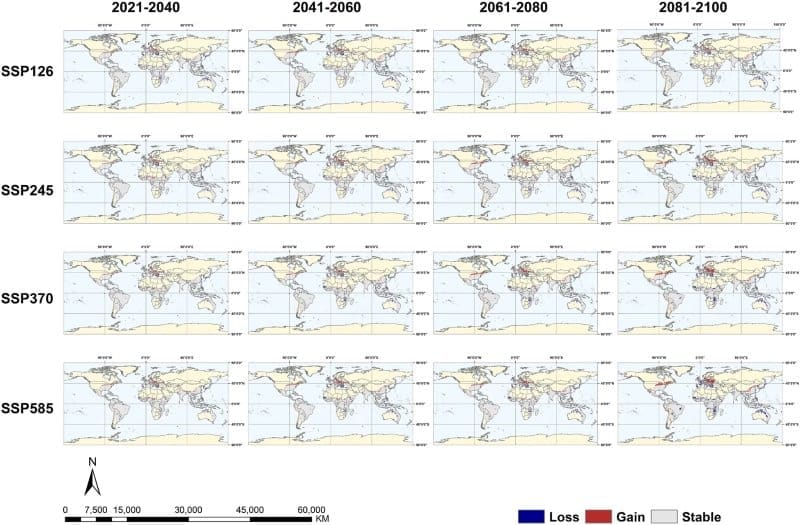
The study found that 21.26% of the world’s land area across 139 countries is currently suitable for chikungunya transmission, mainly in tropical and subtropical regions. But future warming is projected to shift risk northward into northeastern North America, central Europe, and parts of East Asia.
Scientists say the projected expansion is closely linked to the spread of Aedes albopictus, commonly known as the Asian tiger mosquito. Unlike Aedes aegypti, the species can tolerate cooler conditions, increasing the likelihood that chikungunya could establish local transmission cycles in temperate regions.
The researchers say countries with little previous exposure to the virus should strengthen mosquito surveillance, outbreak preparedness, and rapid response systems as climate conditions become more favorable for transmission.
— Press Release —
North America and Europe could become hotspots for chikungunya virus due to climate change
Chikungunya (‘to become contorted’ in the Kimakonde language, named after the characteristic joint ache) is classified as one of the neglected tropical diseases by the World Health Organization. It’s caused by a virus, spread by Aedes mosquitoes. Symptoms include high fever, muscle and back pain, headache, fatigue, nausea, and skin rash.
The European Centre for Disease Prevention and Control has estimated that so far in 2026, there have been approximately 33,000 symptomatic cases of chikungunya worldwide, including nine deaths, predominantly in South America. Currently, the virus isn’t endemic to Europe or North America, where cases are restricted to travelers returning from tropical or subtropical regions.
But this is likely to change by 2100, argues a team of researchers in China in a new study in Frontiers in Cellular and Infection Microbiology.
“At present, 139 countries or regions – accounting for 21.3% of the world’s land area – are risk zones for the chikungunya virus. But we show that under climate change models, the virus will further expand northward into temperate regions, especially northeastern North America, central Europe, and East Asia,” said Dr Ye Xu, a researcher at Zhejiang Chinese Medical University in Hangzhou, China, and one of the study’s corresponding authors.
A plague of mosquitos
Until recently, chikungunya was mainly transmitted by the yellow fever mosquito Aedes aegypti, a species that thrives in human settlements in the tropics.
But when scientists studied the highly publicized 2005–2006 epidemic across Réunion, Mauritius, the Comoros, and parts of India – which made approximately 266,000 people ill and caused at least 254 deaths – they detected a new mutation (‘E1-A226V’) in the virus’s DNA which made it more compatible with an alternative vector, the Asian tiger moth Aedes albopictus.
Here, Xu and colleagues modeled the niche requirements of chikungunya virus and the two mosquito vectors from tens of thousands of geo-tagged records of their presence around the globe. They projected how their current ranges might change between now and 2100, based on 16 climate scenarios developed by the IPCC.
Named for example ‘green shift’, ‘regional rivalry’, and ‘fossil-fueled development’, these scenarios outline five alternative pathways for global socio-economic development. The authors also included 16 variables in their climate models, such as wind speed, elevation, precipitation, and minimum and maximum temperature.
The scientists aimed to identify emerging high-risk regions for chikungunya, to allow public health officials sufficient time to prepare for future outbreaks.
“Our results showed that climate change affects chikungunya mainly by changing where its mosquito vectors can live. In our study, the Asian tiger mosquito was especially important, explaining more than 70% of the predicted distribution of the virus,” summarized Dr Yang Wu from the Guangzhou Customs Technology Center, likewise a corresponding author.
“Because this mosquito can tolerate cooler conditions better than the yellow fever mosquito, warming may allow it to establish in places that used to be too cold. When suitable mosquitoes become established, the chance of local chikungunya transmission increases,” explained Dr Wu.
The time to prepare is now
The precise expansion of the disease depended on the chosen climate scenario, but north-central Europe, northeastern North America, and eastern Asia consistently turned out to be future hotspots. The authors thus counsel that these regions should put mosquito monitoring systems and suitable public health measures into place by 2040.
“The public does not need to panic, but health systems should prepare early,” warned Dr Xu.
“For example, public health officials can act now by tracking Aedes mosquitoes, training doctors to recognize chikungunya quickly, strengthening mosquito control, and setting up rapid-response plans before outbreaks occur. These steps are especially important in temperate regions where the disease has not been a routine public-health concern.”
Limiting further global warming and investing in basic preparedness could reduce the chance that future expansion turns into large outbreaks.”
Journal Reference:
Zhang Q, Zhang L, Ma Y, Jiang Z, Si Y, Zhang T, Jin B, Tao F, Wu Y and Xu Y, ‘Predicting the global risk of chikungunya virus under climate change using ensemble species distribution models’, Frontiers in Cellular and Infection Microbiology 16: 1808175 (2026). DOI: 10.3389/fcimb.2026.1808175
Article Source:
Press Release/Material by Mischa Dijkstra | Frontiers
Featured image credit: FotoshopTofs | Pixabay