Summary:
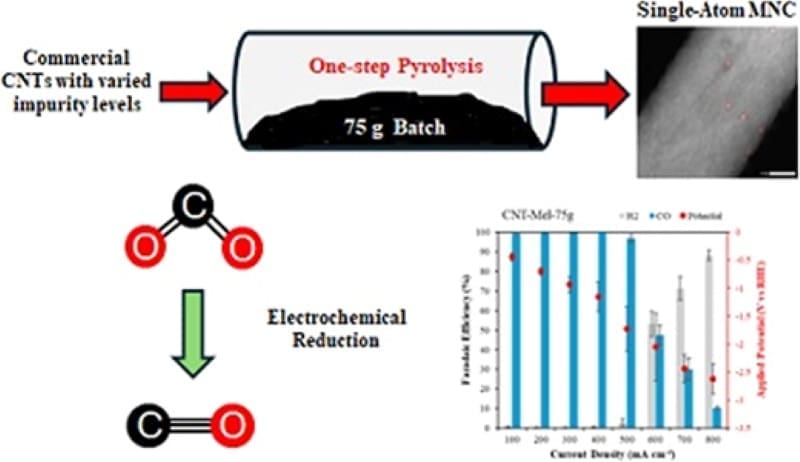
Researchers have developed a single-step method for making metal–nitrogen–carbon catalysts in batches of up to 75 grams, addressing a production challenge for electrochemical conversion of carbon dioxide into carbon monoxide. The approach uses nickel and iron impurities already present in commercial multiwalled carbon nanotubes and requires no additional treatment before or after heating.
In electrochemical tests, the catalysts achieved more than 98% selectivity for carbon monoxide at a current density of 500 mA cm⁻². The researchers also successfully used lower-cost industrial-grade carbon nanotubes, indicating that the method can work with less-pure starting material without sacrificing catalyst performance.
A techno-economic analysis estimated a base-case minimum selling price of $145 per tonne of carbon monoxide, $255 below the market price used for comparison in the study. A life cycle assessment estimated 21% lower CO₂-equivalent emissions compared with the use of benchmark silver catalysts. Published in ACS Omega, the study suggests that larger-scale catalyst production could improve the economic and environmental prospects of electrochemical CO₂ conversion, although long-term operational stability still needs to be demonstrated.
— Press Release —
Researchers turn climate pollution into usable material
A study from University of Mississippi researcher Ahmed Badreldin and Carter Racine, a mechanical engineering doctoral student at Texas A&M University, demonstrated a simpler, lower-cost way to produce carbon-recycling catalysts at much larger scales, addressing one of the biggest barriers to commercial adoption. They published their results in the journal ACS Omega.
“There are plenty of companies out there, particularly startups in the electrochemical energy-conversion space, that have the infrastructure for this ready, but they’re reaching a bottleneck,” said Badreldin, Ole Miss assistant professor of chemical engineering.
“Most advanced nanostructured catalysts are being developed right now at the milligram scale – often around 50 to 100 milligrams – and they’re relying on conventional, silver-based catalysts. We have successfully showcased that in a single synthesis, we can make 75-gram batches without losing performance of advanced single-atom electrocatalysts.”
Carbon dioxide accounts for 80% of the nation’s greenhouse gas emissions from human activities, and the U.S. produced some 5 billion metric tons of carbon dioxide in 2022, the most recent year for which the Centers for Disease Control and Prevention provides data.
Read also: Biochar turns buildings into thermal batteries that cut cooling demand
Instead of releasing carbon dioxide emissions into the atmosphere, where the gas contributes to climate change, researchers want to capture and convert it into carbon monoxide. While poisonous to humans, carbon monoxide is an industrial building block used to manufacture fuels, plastics, pharmaceuticals and other products.
“In the hydrocarbon industry, they often talk about syn gas, which is just carbon monoxide and hydrogen mixed together,” Racine said. “When they’re mixed together, it’s essentially a building block for producing other chemicals that we need.

“It really is the simplest form of carbon we can have, and if we pair it with green hydrogen, we can use those building blocks to make all of the chemicals that would otherwise be produced with virgin fossil fuels.”
Turning carbon dioxide into carbon monoxide is already possible, but the slow rate of catalyst creation has been a stumbling block for efforts to make carbon recycling industry-friendly, Racine said.
“If you’re making 100 milligrams per batch, it would take you a year or more to make enough catalysts to cover 10 square meters of area,” he said. “If we can make 75 grams in a batch – like we are in this study – we can make enough catalysts for a large commercial implementation of these technologies in a few days.”
Producing catalysts in small batches also requires more time and energy, thus, increasing costs.
“‘How much electricity do we need to do this?’ is the biggest consideration,” Racine said. “Being able to do this in larger batches proves the logistics and the feasibility of doing it at a large scale.”
Using a nickel-and-iron single-atom catalyst design, the new catalyst could reduce the cost of recycling to $145 per ton, some $255 below the current market price. It would also have around 25% fewer emissions than current methods.
Read also: Catalyst breakthrough converts CO₂ to fuel in minutes with record efficiency
“The goal right now is largely driven by national security,” Badreldin said. “This could allow the U.S. to establish its own supply chain for the fuels and chemicals that are essential to industry.
“Most of the chemical industries around the world are centralized somewhere, but with this technology, we can decentralize that.”
The setup for the electrochemical process is modular, meaning companies can scale the amount of carbon they recycle to that industry’s need, he said.
“If you are, for instance, trying to use CO₂ to make ethylene or ethanol, which you may need for your production line, you don’t have to have a huge electrochemical plant or buy the product from somewhere that does,” Badreldin said. “You can have a stack sized just large enough to produce the volume you need.
“That’s something you can’t do with the conventional setup.”
The last hurdle to clear is making the process stable enough for industrial use, Racine said.
“Our future research is looking at figuring out long-term stability,” he said. “Big oil and gas plants and other industrial facilities, they run 24/7 for about 350 days of the year and take a week or so off to do maintenance. If we want those facilities to use this, we have to have a model that can operate for nearly a year.
“That’s what we are, and everybody is, trying to figure out now.”
Journal Reference:
Carter Racine, Ahmed Badreldin, John Pellessier, Yayun Chen, Shaoqin Chen, Shengyao Wang, Jin Feng, Chengcheng Fei, Yun Hang Hu, Ying Li, ‘Large-Scale Synthesis (75 g/Batch) of Single-Atom Catalysts for Selective Electrochemical CO₂ Reduction to CO and Commercialization Potential Analysis’, ACS Omega 11 (23): 34554–34567 (2026). DOI: 10.1021/acsomega.6c02693
Article Source:
Press Release/Material by Clara Turnage | University of Mississippi (Ole Miss)
Featured image credit: Racine et al. (2026) | CC BY