Summary:
Forest carbon credits are widely promoted as a tool to help tackle climate change, but a new study suggests many current systems may significantly overestimate their climate benefits. Researchers from Yangtze University and Beijing Normal University argue that several long-standing weaknesses have undermined confidence in forest carbon markets and raised questions about the environmental integrity of many projects.
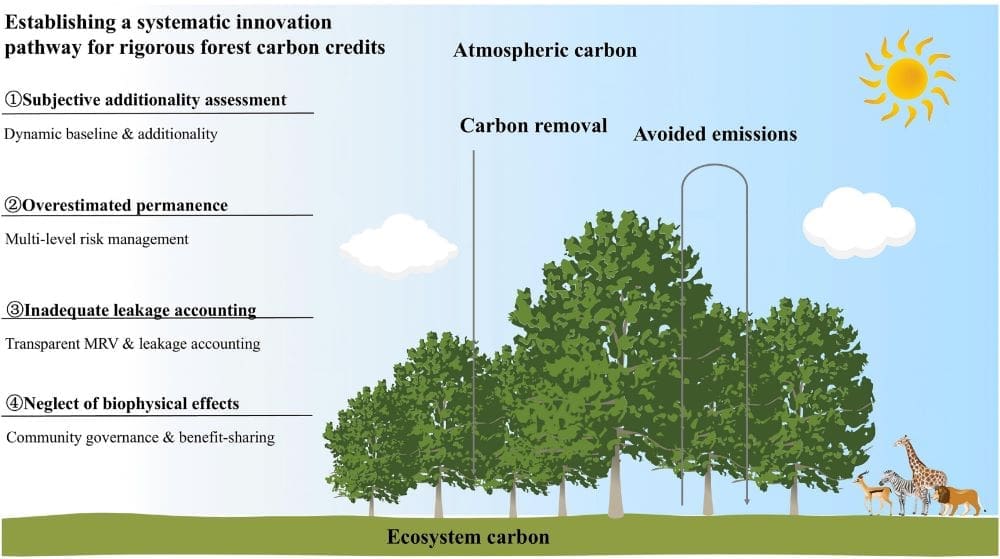
Writing in Biological Diversity, the team identifies four major issues. These include difficulties proving that carbon savings are genuinely additional, overly optimistic assumptions about the long-term storage of carbon in forests, insufficient accounting for emissions that may be displaced elsewhere, and the failure to consider biophysical effects such as albedo, which can influence climate outcomes beyond carbon storage alone.
To address these problems, the researchers propose a framework that combines dynamic baseline monitoring, more conservative leakage calculations, climate risk management measures, and broader assessments of forests’ overall climate effects. The approach also calls for transparent monitoring and verification systems, stronger biodiversity protection, and greater involvement of local communities through formal governance and benefit-sharing arrangements.
According to the authors, stricter standards could reduce the number of carbon credits issued but improve confidence that those credits represent genuine and lasting climate benefits.
— Press Release —
Rebuilding credibility: scientists unveil rigorous framework to fix flawed global forest carbon credit systems
Forests stand as core nature-based climate solutions, absorbing roughly 31% of human-caused carbon dioxide emissions each year. Yet widespread methodological defects have severely compromised the reliability of global forest carbon credit schemes, triggering a severe trust crisis across carbon markets, according to a recent research published in Biological Diversity.
Led by researchers from Yangtze University and Beijing Normal University, the study pinpoints four interconnected structural problems plaguing current forest carbon credit systems.
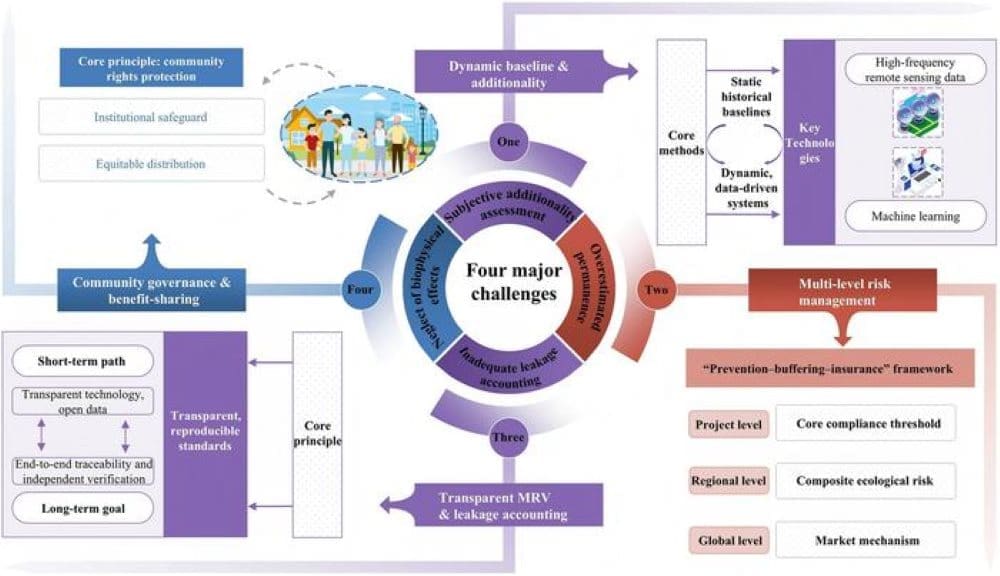
- First, subjective additionality assessments stem from poorly designed static baselines; only 6% of existing REDD+ credits possess solid evidence to prove genuine additional carbon reduction.
- Second, the permanence of carbon storage is drastically overestimated, as existing frameworks ignore growing threats from wildfires, droughts, pest outbreaks and carbon leakage between regions.
- Third, leakage accounting is severely inadequate: current projects apply a mere 7% leakage deduction, far below the empirical range of 10% to 70%, which artificially inflates climate benefits.
- Fourth, most projects overlook key biophysical effects such as albedo and evapotranspiration, which greatly weaken forests’ net cooling effect.
Additionally, insufficient community participation and opaque benefit distribution further threaten the long-term sustainability of these initiatives.
To tackle these intertwined challenges, the team puts forward an integrated, science-driven reform framework covering four core dimensions. For additionality issues, the research advocates replacing static historical baselines with dynamic, data-driven baselines powered by high-frequency remote sensing and machine learning, enabling objective and quantitative additionality verification. To improve permanence, a three-tier “prevention-buffering-insurance” risk management system is designed, which elevates biodiversity conservation to a core compliance requirement rather than a supplementary benefit.
The framework also calls for fully transparent Monitoring, Reporting and Verification (MRV) mechanisms, standardizing monitoring technologies like LiDAR and eDNA, and mandating full disclosure of data and models for independent third-party audits. Meanwhile, researchers stress the necessity of formalizing community governance and equitable benefit-sharing, making Free, Prior and Informed Consent (FPIC) a mandatory rule to secure local support for long-term project operation.
Though the new standards will reduce the total volume of issuable carbon credits, they will produce high-integrity, trustworthy climate assets. The research concludes that systematic standardization and scientific rigor can transform controversial forest carbon credits into stable pillars of global climate governance, realizing the true climate mitigation potential of forests while safeguarding biodiversity and community interests.
Journal Reference:
Chen, Xiaoqian, and Shaokun Li., ‘Restoring Trust: Rebuilding the Forest Carbon Credit System Through Scientific Rigor’, Biological Diversity online ver., 1–5 (2026). DOI: 10.1002/bod2.70026
Article Source:
Press Release/Material by South China Botanical Garden (SCBG) | Chinese Academy of Sciences (CAS)
Featured image credit: Xiaoqian Chen, and Shaokun Li (2026)