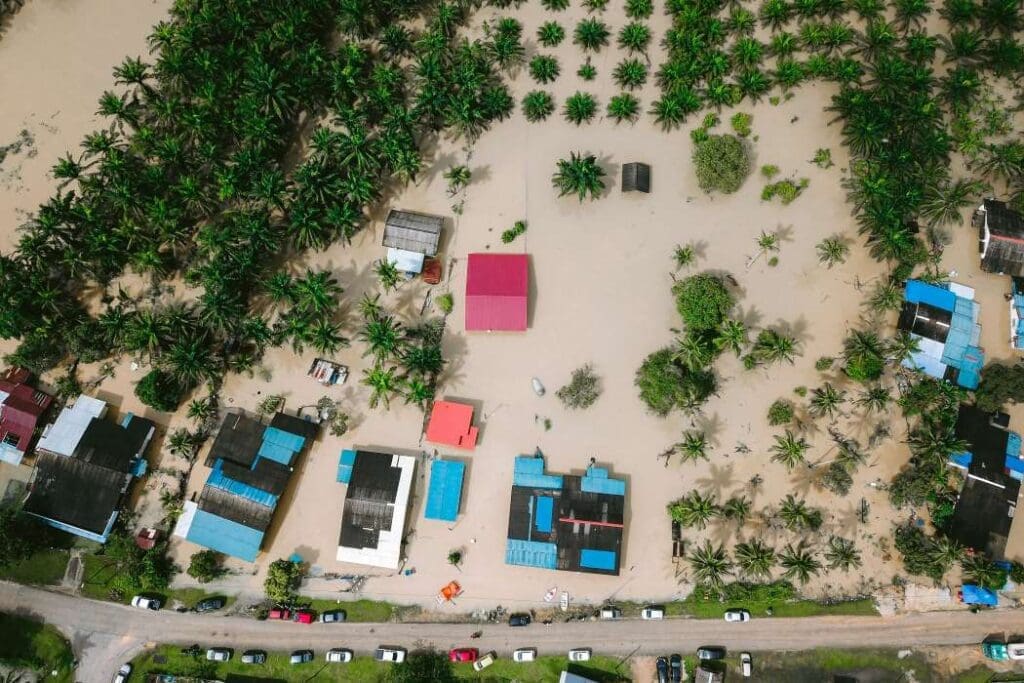
Communities facing one hydrological extreme may increasingly have less time to recover before conditions swing in the opposite direction. New modelling for China suggests that as global temperatures rise, transitions between drought and flood conditions could occur more frequently, affect larger areas and unfold over shorter intervals.
Researchers led by Wei Qi of Guangdong University of Technology (GDUT) examined how these rapid changes could evolve at global warming levels from 1.5 °C to 4.5 °C above the pre-industrial average. Their study, published in PNAS Nexus, combines climate projections, hydrological modelling and socioeconomic data to investigate how the physical characteristics of these events and the exposure of people and economic activity may change with warming.
The team considered three related event types. Drought–flood alternation (DFA) covers changes between drought and flood conditions regardless of which occurs first, while drought-to-flood and flood-to-drought transitions distinguish the direction of the shift. Examining them separately allowed the researchers to determine whether the different sequences respond in the same way to rising temperatures.
The analysis used bias-adjusted climate projections from the Inter-Sectoral Impact Model Intercomparison Project Phase 3b (ISIMIP3b), together with the WEB-DHM-SG global hydrological model. Drought events were identified using a standardized runoff index calculated from simulated discharge, while floods were determined using discharge thresholds linked to spatially varying flood-protection standards. The historical hydrological reference period covered 1985–2014.

Less time between opposite extremes
Across the three event types, warming was associated with a shorter interval between drought and flood conditions. The mean interval fell from 30.38 days during the historical period to 24.17 days at 4.5 °C of warming. Averaged across the warming levels examined, it decreased by 1.44% for every additional 0.5 °C.
The number of events increased at the same time. The researchers calculated a mean rise of 10.09% in frequency for each additional 0.5 °C of warming, while the area affected increased by an average of 9.22%. The relationships between warming and all three measures examined, the interval between events, frequency and affected area, were statistically significant.
The changes were not uniform across event types. Drought-to-flood transitions showed particularly strong sensitivity to warming, while flood-to-drought transitions generally changed more gradually. The study also found that drought-to-flood transitions shifted toward earlier timing as temperatures increased, with their end dates showing a significant advance.
Geographical patterns also varied across China. High-frequency zones generally expanded with warming, particularly across southern China. For broader drought–flood alternation events, some of the strongest increases were projected in the middle and lower Yangtze region, Sichuan and parts of southwestern China, while affected areas expanded across several major regions, including the Yangtze River Basin and northern China.
These patterns matter because drought and flood are often considered separately in risk assessments. A rapid shift from one to the other presents a different planning problem: the period available to recover from one hazard and prepare for the next becomes smaller. The study describes these successive events as a form of compound risk that can be overlooked when each extreme is assessed in isolation.
Exposure rises unevenly across income groups
The researchers also mapped how changing drought–flood patterns could affect human and economic exposure. For drought–flood alternation events, population exposure increased from 247 million people in the historical baseline to 401 million at 4.5 °C of warming. Estimated gross domestic product exposed to these events rose from US$9.06 trillion to US$27.4 trillion over the same comparison.
The largest absolute exposure remained concentrated in economically developed and densely populated regions. This means wealthier areas can account for a larger overall share of exposed people and economic activity even when proportional increases are greater elsewhere.
A different pattern appeared when the researchers compared how quickly exposure increased across income groups. For drought–flood alternation events, human exposure rose by an average of about 13% per 0.5 °C of warming among populations in the study’s extreme-poverty category, compared with 8.5% among the high-income group. Relative increases in economic exposure were also greater across the three non-high-income groups than in the high-income category.

The distinction between absolute and relative exposure is important. High-income regions remain home to more of the people and economic assets exposed overall, while lower-income populations experience steeper proportional increases as temperatures rise. The study therefore does not suggest that poorer regions necessarily face the greatest exposure in absolute terms, but rather that their relative burden grows faster.
For the authors, the results point to a need for climate adaptation and disaster planning to consider how quickly hydrological conditions can reverse, not only the individual occurrence of droughts and floods. As warming increases, communities may face more frequent shifts across larger areas while having less time between opposing extremes.
The authors also note that the projections carry uncertainties related to climate forcing, hydrological model parameters, spatial processing and the thresholds used to identify droughts and floods. Local infrastructure, reservoir operation, drainage capacity and flood-protection conditions may not be fully represented at the national scale.
Planning for rapid transitions could therefore become increasingly important in places where exposure is already high or growing quickly. Treating drought and flood as entirely separate hazards may miss the additional pressure created when one follows closely after the other.
Journal Reference:
Wei Qi, Ruiting Huang, Yanpeng Cai, Qian Tan, Minglei Ren, Yanli Liu, ‘Warming accelerates drought–flood oscillations and stratifies socioeconomic exposure’, PNAS Nexus 5, 9, pgag283 (2026). DOI: 10.1093/pnasnexus/pgag283
Article Source:
Press Release/Material by PNAS Nexus
Featured image credit: Qi et al. (2026) | CC BY-NC