Summary:
How climate mitigation is divided between regions can alter the course of the global energy transition while preserving the same overall temperature outcome. Researchers led by the International Institute for Applied Systems Analysis (IIASA) incorporated fair-share principles directly into climate scenario modelling, accounting for differences in regional responsibility and economic capability. Their research, published in Environmental Research Letters, examines how different approaches to cooperation can change where emissions reductions take place.
When financial transfers were restricted to the lowest feasible level, higher-responsibility regions made deeper domestic emissions cuts. In scenarios consistent with returning to around 2 °C of warming, this reduced global fossil fuel use in 2040 by 3% to 21%, while renewable energy deployment, electrification and cumulative emissions through 2100 remained broadly similar.
Including fair-share constraints raised the estimated reduction in global consumption from about 0.8% in the cost-effective pathway to no more than 1.3% relative to a no-new-policy scenario. Lower-responsibility regions had better consumption outcomes than in the cost-effective pathway. Under a more stringent 1.5 °C pathway, less scope remained for shifting physical emissions reductions between regions, increasing the role of financial cooperation.
Read also: Outgoing UN chief makes climate push at New York summit
— Press Release —
Fairness informs how the world cuts emissions
Who cuts emissions fastest, and who supports others do so, are central questions in global climate action. New IIASA-led research shows that building fairness into climate models from the start can inform deliberations without changing the overall climate goal.
The study, published in Environmental Research Letters, builds fair-share considerations directly into the process used to generate climate mitigation scenarios, rather than assessing fairness only afterwards. The result is a wider range of possible pathways: the same global climate outcome can be reached with different combinations of emissions cuts and financial support across regions. The authors conclude that fairness is a defining feature of feasible collective ambition.
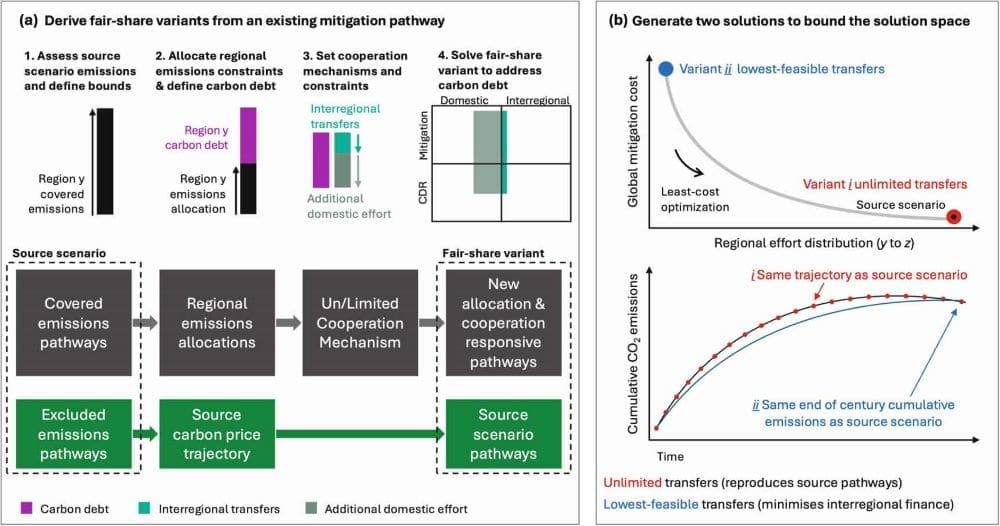
The researchers describe an approach that starts from an existing global mitigation pathway, allocating its emissions budget across world regions according to different principles of fairness including, for example, responsibility and economic capability. Regions that have already emitted, or are projected to emit, more than their share carry a carbon debt, which they can close by cutting emissions faster at home, removing CO₂ from the atmosphere, or supporting a range of mitigation activities in other regions through interregional finance. The model then finds the least-cost way to meet both the global climate goal and every regional fair share.
Demonstrating this using the IIASA MESSAGEix-GLOBIOM-GAINS integrated assessment modeling framework, the researchers first examined a scenario consistent with limiting warming to approximately 2 °C at 67% likelihood while allowing warming to temporarily exceed this limit before returning to it.
The authors compared two contrasting ways of meeting each region’s fair share. In the first, regions can make unlimited financial transfers to support mitigation elsewhere. In this case, the physical transition remains the same as in the cost-effective pathway, while US$ 10.1 to US$ 44.8 trillion (NPV) is transferred between regions over 2026 to 2100, depending on the fairness principle.
They then asked what happens when regions cannot rely on such large financial transfers and must do more at home. The results show that when transfers are reduced to the lowest feasible level, they fall by more than half and higher-responsibility regions cut emissions faster domestically. As a result, global fossil fuel use in 2040 is 3% to 21% lower, while the overall trajectories for renewables, electrification, and cumulative emissions by 2100 remain unchanged.
Read also: Global fossil fuel phase-out could require up to 80% more electricity
The additional economic cost is relatively small and progressive: compared with a future with no new climate policy, global consumption falls by about 0.8% in the cost-effective pathway examined, which increases to at most 1.3% when fair share considerations are integrated and transfers are constrained. Regions with lower responsibility and capability see net improvements to consumption relative to the cost-effective pathway in all cases.
“Integrating fair shares into the scenario generation process changes the shape of the transition, while preserving the climate outcome. Such fair share scenario variants provide new evidence that can inform the translation of global ambition to regional implementation,” says lead author Setu Pelz, a researcher in the IIASA Energy, Climate, and Environment Program.
How regions cooperate also matters. Restricting cooperation to financing carbon removal with geological storage alone costs roughly ten times as much per tonne of mitigation transferred as when all mitigation options (except land-use) are in scope, and higher-responsibility regions still meet most of their obligations through domestic emission cuts.
“Fairness is often assessed after the most cost-effective global pathway has been identified. Our results show why it matters to bring it into the analysis from the beginning: doing so reveals different ways of sharing the effort while still achieving the same global climate outcome,” explains coauthor Shonali Pachauri, who leads the Transformative Institutional and Social Solutions Research Group at IIASA.
“There is more than one way to deliver a given climate goal. The balance between domestic emissions cuts and financial cooperation can change substantially, with consequences for how regional energy systems evolve,” adds coauthor Oliver Fricko, a senior researcher in the IIASA Energy, Climate, and Environment Program.
The authors repeated the analysis for a scenario consistent with returning to 1.5 °C at 50% likelihood at the end of the century, again with warming temporarily exceeding the limit before returning to it. They found that a range of pathways persists, but there is less room to shift where physical emissions cuts take place, meaning finance plays a greater role. Compared with the 2 °C case, the amount of finance needed roughly doubles when regions can rely freely on transfers and remains closer to this level when transfers are constrained due to the limits on feasible physical effort reallocation.
The researchers emphasize that financial transfers represent aggregate flows between world regions rather than proposals for specific carbon markets or mechanisms, and that future climate assessments should routinely consider fair share as well as cost-effective pathways, particularly as countries prepare their next nationally determined contributions and the second Global Stocktake.
The study’s figures, pathways, and regional results can be explored in more detail using an interactive online explorer developed by the authors.
***
This research received funding from the European Union’s Horizon Europe Research and Innovation Programme under Grant Agreement No. 101056873 (ELEVATE) and from the European Research Council under Grant No. 951542-GENIE-ERC-2020-SyG (GENIE).
Read also: Clean energy subsidies work best when pollution has a price
Journal Reference:
Pelz, S., Fricko, O., Riahi, K., Pachauri, S., Brutschin, E., Rogelj, J., Krey, V., Johnstone, I., Vinca, A., Schleussner, C-F., Kikstra, J., Gidden, M.J., ‘Equitable cooperation deepens the solution space for high ambition pathways’, Environmental Research Letters 21, 18, 184019 (2026). DOI: 10.1088/1748-9326/aea34d
Article Source:
Press Release/Material by Ansa Heyl | International Institute for Applied Systems Analysis (IIASA)
Featured image credit: Muser Press (AI Gen.)