Exposure to sunlight and other environmental conditions can change the properties of microplastics, influencing how they interact with chemicals, organic matter and microorganisms. These processes are attracting growing scientific attention as researchers investigate the wider environmental consequences of plastic pollution.
Three scientific papers published in Environmental and Biogeochemical Processes examine different aspects of this problem. Two report laboratory experiments involving the chemical behavior of microplastics in water, while a third reviews evidence of their effects on microorganisms responsible for important soil processes.
Together, the papers offer complementary perspectives on how plastic particles interact with their surroundings, although they investigate different mechanisms and do not establish a common environmental outcome.
Aging microplastics change chromium chemistry in water
In a study published on October 9, 2026(1), researchers at Northeast Normal University in China, working with scientists from Tianjin University and the Chinese Academy of Sciences, investigated how ultraviolet aging affects the interaction between polystyrene microplastics and hexavalent chromium, a toxic form of the metal that can move relatively easily through water.

The researchers found that ultraviolet exposure generated environmentally persistent free radicals on the plastic surfaces and increased the release of dissolved organic matter from the particles. Both processes contributed to the conversion of hexavalent chromium, known as Cr(VI), into trivalent chromium, or Cr(III), which is generally less mobile and less toxic under many environmental conditions.
The two processes followed different chemical pathways. Free radicals on the aged plastic surfaces primarily contributed through direct electron transfer, while organic compounds released from the particles promoted chromium reduction through reactions involving superoxide radicals generated under ultraviolet light.
Under ultraviolet irradiation in the laboratory, chromium reduction increased from 38.11% with unaged polystyrene to 89.90% with particles subjected to 96 hours of accelerated aging.
These results demonstrate that weathered microplastics can participate in chemical transformations involving toxic metals. However, they do not mean that plastic pollution improves water quality. The experiments examined a specific reaction under controlled conditions, and further research is needed to determine its importance in natural waterways.
How weathering affects interactions with organic matter
A separate study published on March 30, 2026(2) investigated how environmental aging changes the interaction between microplastics and naturally occurring dissolved organic matter in water.
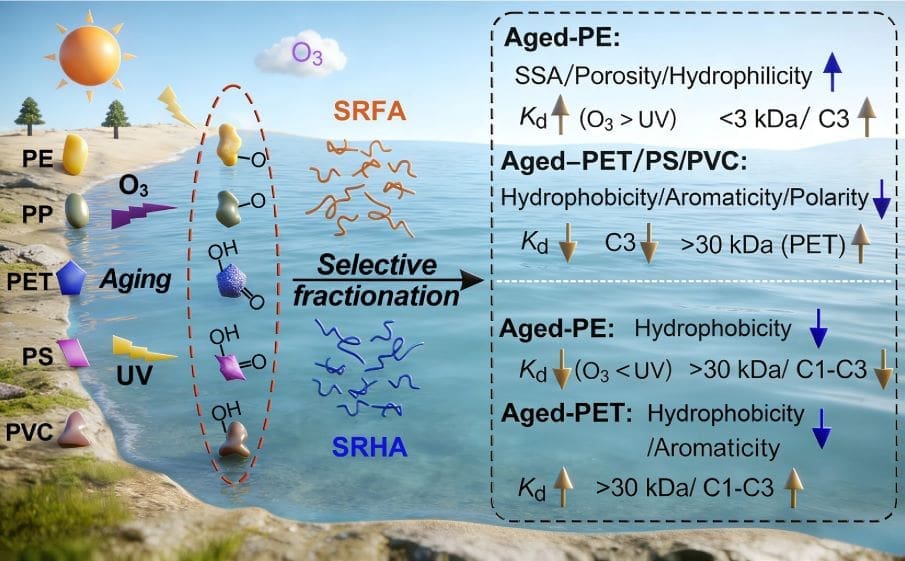
Scientists from Nankai University in China, the University of Vienna in Austria and other institutions examined five common polymers, including polyethylene, polypropylene, polystyrene, polyethylene terephthalate and polyvinyl chloride.
The particles underwent controlled ultraviolet and ozone treatments before being exposed to two representative forms of dissolved organic matter, fulvic acid and humic acid. These substances are components of the complex mixture of organic compounds found in natural waters.
The experiments showed that aging modified plastic surfaces and influenced both the amount and composition of organic matter they retained. The responses differed according to polymer type, aging treatment and the characteristics of the organic compounds.
For polyethylene and polypropylene, aging favored the retention of smaller, more water-attracting fractions of fulvic acid. Other polymers displayed different patterns, demonstrating that weathering does not produce uniform changes across plastic materials.
Using machine-learning-assisted analysis, the researchers identified specific surface area and surface carbon chemistry as important predictors of these interactions.
Although both aquatic studies examined the chemical behavior of aging microplastics, they addressed distinct processes. The chromium investigation focused partly on organic matter released from polystyrene during aging, whereas the second examined naturally occurring organic compounds attaching to plastic surfaces.
These differences matter because the composition and origin of organic matter can influence how microplastics interact with other substances in water. The research provides insight into those interactions, but does not directly establish how they affect contaminant movement or aquatic ecosystems under natural conditions.
Microplastics and the hidden processes in soil
Microplastics may also influence biological processes in soil, where microorganisms play essential roles in decomposing organic matter and recycling nutrients.
A scientific review published on February 12, 2026(3) examined previous research on how microplastic contamination affects soil microorganisms and the functional genes involved in important ecosystem processes.
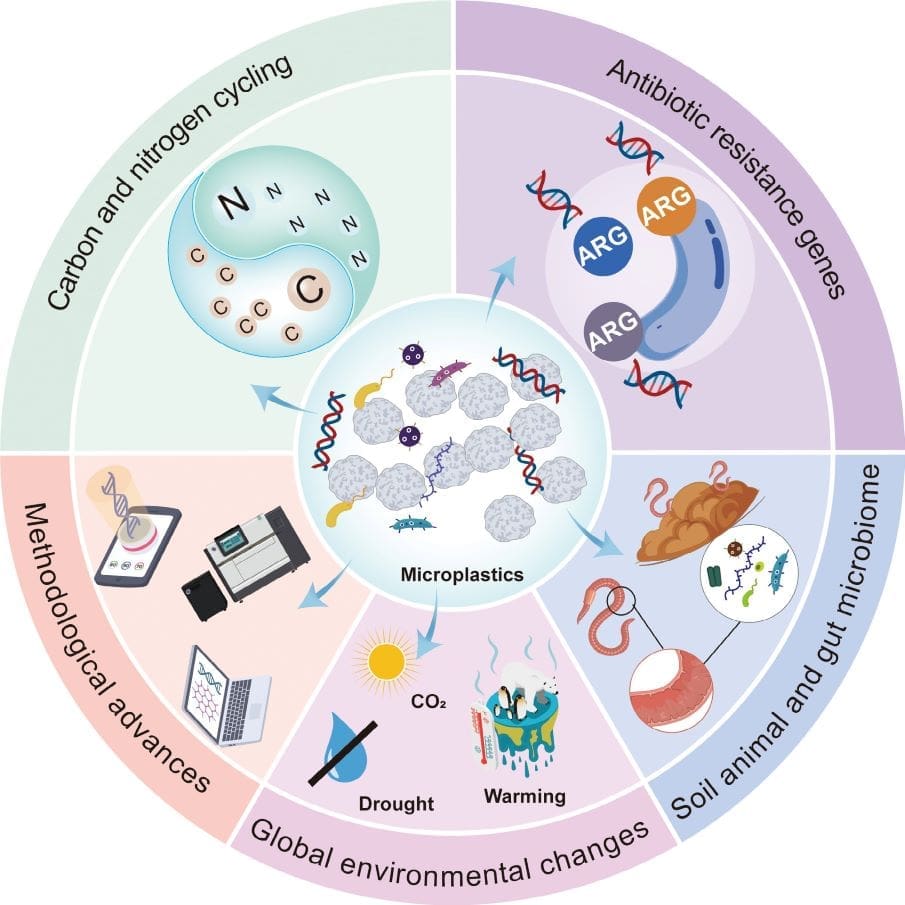
Researchers from Henan University, the Chinese Academy of Sciences and other institutions assessed evidence that microplastics can alter soil properties, microbial habitats and genes associated with carbon and nitrogen cycling.
Changes in microbial communities and functional genes may affect organic matter decomposition, nutrient transformations and greenhouse gas production, although the responses depend on the conditions studied. The direction and extent of these effects vary with plastic characteristics, soil conditions and other environmental factors.
The review also examined interactions between microplastics and antibiotic resistance genes. Microbial communities living on plastic surfaces, together with those in the digestive systems of soil animals, may provide environments where these genes become concentrated and potentially exchanged between microorganisms.
These observations raise questions about the longer-term consequences of plastic contamination for soil microbial communities, but they do not establish a direct connection between microplastics in soil and antibiotic-resistant infections in humans.
The authors further considered how warming, drought and elevated atmospheric carbon dioxide may modify microbial responses. Because much of the existing evidence comes from laboratory studies, the long-term implications for natural soils remain uncertain.
Unlike the two aquatic investigations, the soil paper synthesizes previously published research rather than presenting new experimental results. Its conclusions therefore draw on studies conducted under different conditions, making comparisons and broader predictions more difficult.
Considered together, the three papers demonstrate why understanding microplastic pollution requires more than measuring the amount of plastic accumulating in the environment. The composition of particles, their exposure to environmental conditions and their interactions with surrounding substances can all influence how they behave.
This perspective connects with a broader question explored in an earlier Muser Press feature on the environmental consequences of persistent pollution. Synthetic materials may remain in the environment for long periods even as their properties and interactions with natural systems continue to change.
The three papers do not establish a single mechanism connecting chemical reactions in water with microbial responses in soil, nor do they determine the cumulative effects of these processes across ecosystems.
They show, however, that microplastics are not necessarily inactive particles once released into the environment. Their chemical characteristics and interactions can change over time, introducing additional complexity into assessments of plastic pollution.
Determining how these processes unfold under natural conditions, and whether they lead to lasting changes in water quality, soil functioning and ecosystem health, remains an important challenge for environmental research.
Journal Reference:
(1) Wang X, Tang X, Wang D, Gu L, Zhang X, et al., ‘Microplastics as emerging mediators of Cr(VI) reduction: roles of environmentally persistent free radicals and microplastic-derived dissolved organic matter’, Environmental and Biogeochemical Processes 2: e020 (2026). DOI: 10.48130/ebp-0026-0015
(2) Zhang X, Lin Y, Zhao M, Zhu M, Cao T, et al., ‘Polymer type, environmental aging, and DOM compositions collectively control DOM fractionation on microplastics’, Environmental and Biogeochemical Processes 2: e009 (2026). DOI: 10.48130/ebp-0026-0004
(3) Wang H, Ma L, Xie L, Xie T, Zhang S, et al., ‘Effects of microplastic on soil ecosystems: a perspective from functional genes’, Environmental and Biogeochemical Processes 2: e008 (2026). DOI: 10.48130/ebp-0026-0003
Article Source:
Press Release/Material by Maximum Academic Press
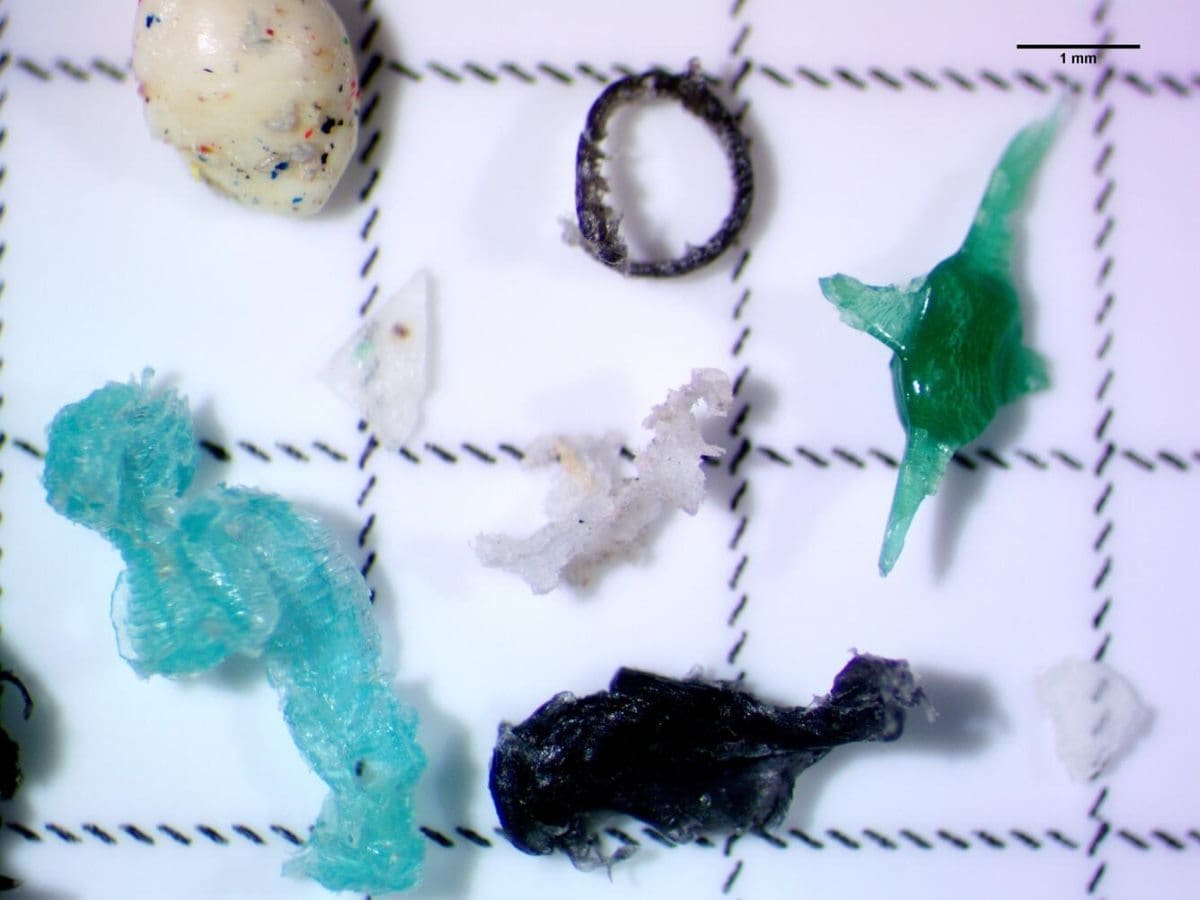
Featured image: Microplastic fragments viewed under a microscope. Research suggests that these particles can undergo chemical changes and interact with substances and microorganisms in their surroundings. Credit: U.S. Geological Survey (USGS) | Public Domain