The warming waters of the Pacific Ocean bring far-reaching consequences, but few are as immediate as the rise in mosquito infestations linked to dengue, chikungunya, and zika.
A new study has revealed how El Niño, the periodic climate phenomenon, drives increased breeding of Aedes aegypti mosquitoes across São Paulo state, Brazil, amplifying public health risks.
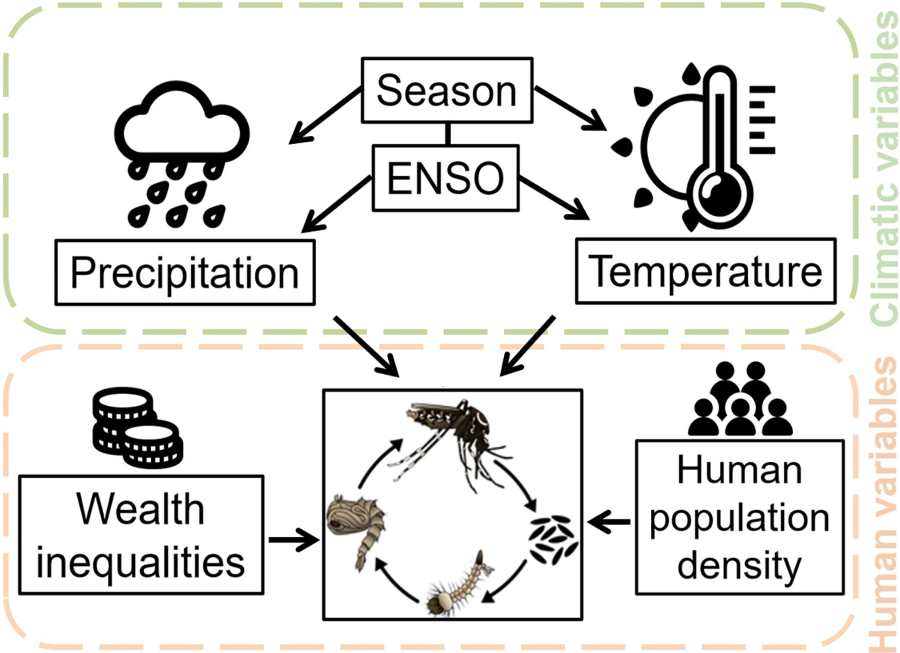
The research, published in PLOS Neglected Tropical Diseases, analyzed data from 645 municipalities between 2008 and 2018. It showed that seasonal temperatures above 23.3°C and rainfall exceeding 153 millimeters – a hallmark of El Niño events – correlate with surges in mosquito larval infestations.
The study relied on the Breteau Index, a metric that measures the presence of mosquito larvae in containers per property inspected, to identify a significant increase during El Niño years.
“We didn’t analyze dengue cases in the period. We focused on levels of larval infestation, which on their own don’t serve as indicators of cases. However, the number of cases notified will rise if vector infestation increases, since dengue virus is circulating in São Paulo state,” said Gerson Laurindo Barbosa, statistician and epidemiologist at the Pasteur Institute in São Paulo, co-author of the study.
The findings indicate that central and northern regions of São Paulo state are particularly vulnerable. The researchers also highlighted the influence of social disparities on mosquito proliferation, calling for targeted interventions in high-risk areas.
“If an El Niño is predicted – and it’s possible to predict it – we can combine data for all these areas to optimize and target surveillance, and to implement timely control actions,” said author Francisco Chiaravalloti Neto, a professor at the University of São Paulo’s School of Public Health.
The urgency of such measures is underscored by Brazil’s ongoing struggle with mosquito-borne diseases. As of October 2023, the country experienced its worst dengue epidemic on record, with over 6.54 million probable cases and 5,696 deaths. São Paulo state alone accounted for 32% of these cases (2.1 million), with its capital reporting nearly 10% of the total.
El Niño’s climatic disruptions – such as above-average rainfall in southern São Paulo and extreme heat in much of Brazil – create conditions ripe for mosquito breeding. Researchers say these patterns are expected to intensify in coming decades due to climate change.
The study calls for urgent advancements in detection methods for mosquito breeding sites to combat the growing threat.
The research team also faced challenges in obtaining data across São Paulo’s municipalities. “Many cities have neither information nor databases. Doing an experiment in an academic setting, transforming the results into a scientific paper and putting them at the disposal of public administrators for use in policymaking is very important,” said Thiago Salomão de Azevedo, an ecologist and geographer, co-author of the study.
By identifying areas most at risk, the researchers hope their work can support policymakers in directing resources where they are needed most. “The sharper the focus of our work, the more the human and financial resources involved can be optimized,” Barbosa added.
Journal Reference:
Pirani M, Lorenz C, de Azevedo TS, Barbosa GL, Blangiardo M, Chiaravalloti-Neto F, ‘Effects of the El Niño-Southern Oscillation and seasonal weather conditions on Aedes aegypti infestation in the State of São Paulo (Brazil): A Bayesian spatio-temporal study’, PLOS Neglected Tropical Diseases 18 (9): e0012397 (2024). DOI: 10.1371/journal.pntd.0012397
Article Source:
Press Release/Material by Fundação de Amparo à Pesquisa do Estado de São Paulo
Featured image credit: jcomp | Freepik