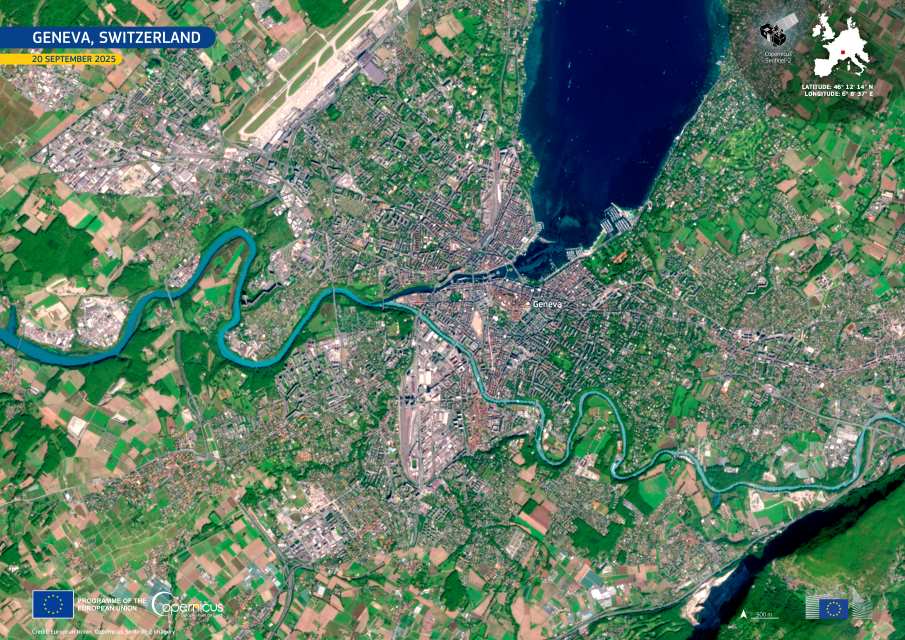
Each year in late April, the farmland of southern Romania turns brilliant yellow as rapeseed plants come into flower. Captured by the Copernicus Sentinel-2 satellite on 29 April 2025, this image shows a mosaic of blooming fields near Bucharest. From orbit, the flowering crops appear as irregular golden-green patches that break up the darker tones of nearby vegetation and cultivated land.
The plant behind this transformation — rapeseed, also known as canola in its low-acid variant — is part of Romania’s core agricultural output. Along with sunflower seeds and soybeans, it plays a vital role in the country’s oilseed sector. These crops form the foundation of Romania’s standing as a leading producer within the European Union. In an average year, Romania accounts for approximately 10 percent of the EU’s total grain and oilseed harvest, with large shares coming from its southern and southeastern regions.
Rapeseed belongs to the Brassica genus, a family that includes cabbages, mustards, and turnips. During spring, its fields are covered in thousands of compact plants topped with small, intensely yellow flowers. These blooms are more than ornamental. Once pollinated, they develop into narrow seed pods that resemble peas and contain numerous tiny seeds with a high oil content. The harvested seeds are crushed to extract oil used across multiple industries — from culinary products to biofuels and even lubricants and solvents.
The oil derived from rapeseed is known for its versatility. Canola oil, in particular, is a widely used cooking product developed through selective breeding to lower its levels of erucic acid. In Romania and other European nations, both traditional and modified rapeseed varieties are grown depending on climate, soil conditions, and end-use markets.

In the broader context of agriculture and climate, oilseed production in Romania has become increasingly sensitive to environmental pressures. Episodes of drought and high temperatures over the past decade have led to sharp annual variations in crop yields. As a result, satellite-based monitoring tools have become indispensable for farmers, policymakers, and researchers alike.
The Sentinel-2 satellite, part of the European Union’s Copernicus Earth observation program, delivers detailed images that help monitor land use, assess crop development, and support forecasts of seasonal production. This kind of near-real-time data has become a key asset for modern farming — particularly in regions where weather volatility affects planting decisions and expected output.
The April bloom captured in this image marks a period of rapid biological activity. Beyond the visual spectacle, this phase is critical for crop viability and eventual oil yield. Pollination during the bloom stage directly affects the quality and volume of the final harvest. Monitoring these fields from space enables early detection of problems such as nutrient deficiency, disease, or water stress, giving farmers a chance to respond before the damage becomes irreversible.
Romania’s agricultural sector continues to evolve with changing climate conditions and international demand. Alongside rapeseed, crops like sunflowers, soybeans, corn, wheat, and barley dominate the national landscape, ensuring a diverse and export-oriented farming economy. Oilseeds in particular have gained prominence, not only for food products but also for renewable energy initiatives tied to the EU’s broader climate goals.
From a satellite’s perspective, the rapeseed bloom offers a striking visual symbol of this intersection between traditional farming and advanced technology. The golden fields seen in the Sentinel-2 image aren’t just picturesque — they represent a snapshot of one of Europe’s key agricultural systems in motion, shaped by both nature and data.
Featured image credit: European Union, Copernicus Sentinel-2 imagery