
Explore the latest insights from top science journals in the Muser Press roundup (January 12, 2026), featuring impactful research on climate change challenges.
In brief:
— Press Release —
Environmental ‘superbugs’ in our rivers and soils: new one health review warns of growing antimicrobial resistance crisis
A growing environmental ‘superbug’ crisis
Antimicrobial resistance (AMR) occurs when bacteria and other microbes evolve the ability to survive medicines that once killed them, making common infections harder or impossible to treat. The World Health Organization already lists AMR as one of the most serious global health threats of this century, with some estimates warning of tens of millions of deaths and massive economic losses if action fails.
A new study published in Biocontaminant shows that the environment is not just a passive backdrop. Rivers, lakes, soils, oceans, and even air can carry resistance genes and resistant bacteria that move between wildlife, livestock, and people, helping create a truly global network of AMR.
Key sources and hidden reservoirs
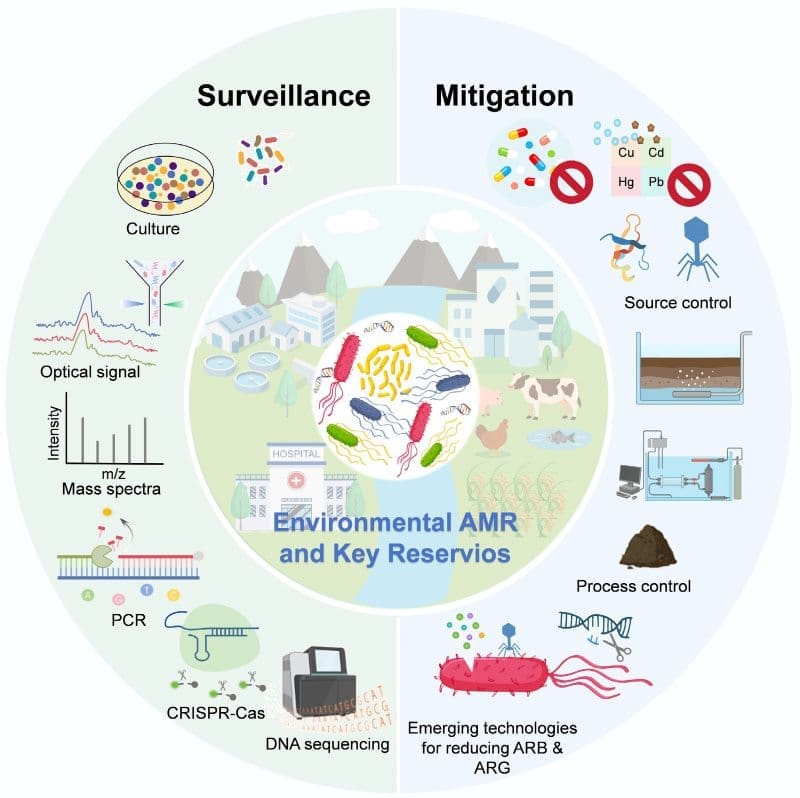
The review highlights several major environmental “hotspots” where resistance builds up and spreads.
- Hospital and city wastewater treatment plants act as central mixing hubs, collecting antibiotic residues, resistant pathogens, and mobile genetic elements from homes and clinics. Conventional treatment often fails to fully remove these contaminants, allowing resistance genes to persist in effluent water and sewage sludge;
- Livestock farms and aquaculture systems use large quantities of antibiotics, enriching resistance genes in animal gut microbes and manure that then reach soils, crops, and surrounding waters;
- Pharmaceutical manufacturing facilities can discharge extremely high levels of both antibiotics and resistance genes, raising the risk that dangerous resistance traits spread downstream.
Across these sites, resistance genes can hitchhike on mobile genetic elements such as plasmids, making it easier for bacteria to “swap” resistance traits and create multidrug resistant strains.
Why traditional monitoring is not enough
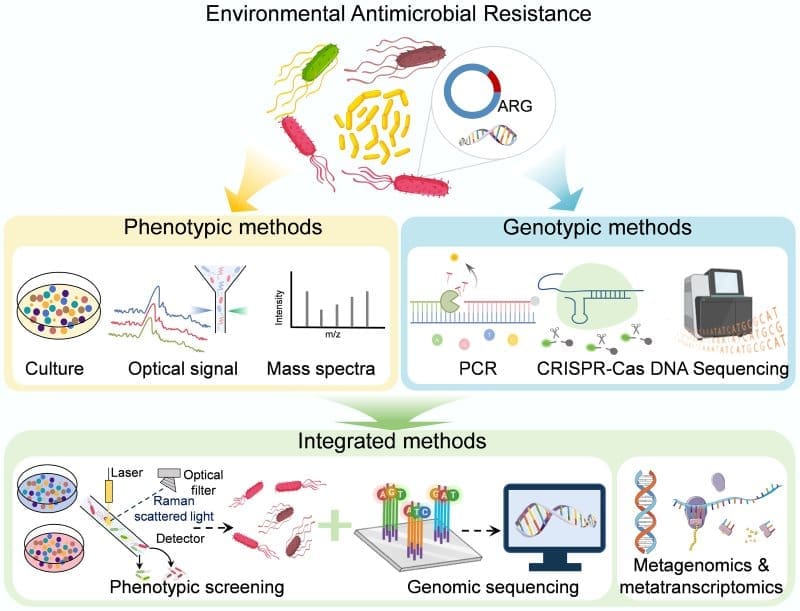
Most AMR surveillance still focuses on clinical samples, but the authors argue that environmental monitoring needs to catch up. Classic culture based tests remain important because they measure whether bacteria actually survive antibiotics, and they provide live isolates for further study. However, many environmental bacteria cannot be grown easily in the lab, and these methods can miss most of the resistance present.
Newer tools are rapidly changing the picture:
- Phenotypic methods such as flow cytometry and Raman spectroscopy can track resistant cells and gene transfer in complex samples within hours, without requiring cultivation;
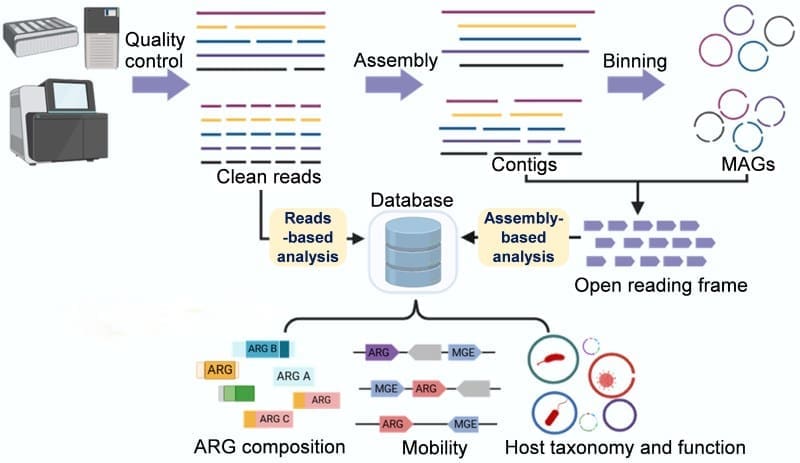
- Genotypic methods such as high throughput quantitative PCR, CRISPR based assays, and metagenomic sequencing can detect hundreds of resistance genes at once, and identify which bacteria carry them;
- Long read sequencing now allows researchers to reconstruct entire mobile genetic elements and see exactly how resistance genes are organized and move between hosts.
“The message is clear,” said lead author Huilin Zhang. “No single method can capture the full story of environmental resistance. What we need is integrated surveillance that links what bacteria can do to what genes they carry, and where they are spreading.”
One Health and smarter mitigation
The review is framed within the One Health concept, which emphasizes that human, animal, and environmental health are tightly connected. The authors propose tackling AMR on two fronts source control to reduce the amount of antibiotics, resistant bacteria, and resistance genes entering the environment, and process control to intercept them along key pathways such as wastewater treatment.
Source control measures include stricter antibiotic stewardship in medicine and agriculture, better regulation in low and middle income regions, and cleaner production in pharmaceutical industries. The authors also highlight emerging “green” solutions, such as enhanced biodegradation of antibiotics, design of more biodegradable drugs, and alternative antimicrobials like peptides and phages.
On the process side, improved wastewater treatment and waste management are crucial. Conventional disinfection can reduce many resistant bacteria but may leave resistance genes intact, especially in solid waste streams. More advanced approaches such as hyperthermophilic composting, advanced oxidation, membrane processes, nanomaterials, bacteriophage based treatments, engineered DNA scavenging bacteria, and CRISPR based tools show promise but require further research, safety evaluation, and cost reduction.
Focusing on the riskiest resistance
Instead of simply counting how many resistance genes exist, the authors argue that surveillance and policy should prioritize traits that really drive health risk. Three stand out:
- Mobility: how easily genes move between bacteria and environments;
- Host pathogenicity: whether the bacterial hosts are capable of causing disease in humans or animals;
- Multi resistance: whether genes and their hosts resist multiple key antibiotics, limiting treatment options.
“Environmental AMR is not just about how many resistance genes we can find,” said corresponding author Feng Ju. “What matters most is which genes are mobile, which pathogens carry them, and how they evolve in real world ecosystems. That is where surveillance must focus, and where mitigation will have the biggest impact.”
The authors call for global, standardized protocols that make environmental AMR data comparable across countries and over time. Without such standards, they warn, the world will struggle to spot emerging threats early enough and to design effective One Health interventions that protect both people and the planet.
Journal Reference:
Zhang H, Luo Y, Zhu X, Ju F., ‘Environmental antimicrobial resistance: key reservoirs, surveillance and mitigation under One Health’, Biocontaminant 1: e022 (2025). DOI: 10.48130/biocontam-0025-0023
Article Source:
Press Release/Material by Biochar Editorial Office | Shenyang Agricultural University
— Press Release —
World’s vast plant knowledge not being fully exploited to tackle biodiversity and climate challenges, warn researchers
In a new report published in the journal Nature Plants, researchers based at more than 50 botanic gardens and living plant collections warn that a patchwork of incompatible, or even absent, data systems is undermining global science and conservation at a critical moment.

They call for a unified and equitable global data system for living collections to transform how the world’s botanic gardens manage and share information. This would enable them to work together as a ‘meta-collection’ to strengthen scientific research and conservation efforts.
Climate change, invasive species, habitat loss and increased global movement of plant material all require rapid access to high-quality, trusted information about living plants. Achieving this depends on a shared culture of open, accurate, and affordable data – allowing living collections of all sizes, particularly in the Global South where much of the world’s biodiversity is located, to participate on equal terms.
Curator of Cambridge University Botanic Garden Professor Samuel Brockington, who led the work together with researchers at Botanic Gardens Conservation International, said: “The digital infrastructure needed to manage, share, and safeguard living plant diversity wasn’t designed to operate at a global scale.”
He added: “We’ve built an extraordinary global network of living plant collections, but we’re trying to run twenty-first-century conservation with data systems that are fragmented, fragile, and in many cases inaccessible to scientists and conservationists working where most biodiversity originates. We urgently need a shared data system so the people managing collections can work together as a coordinated whole.”

Thaís Hidalgo de Almeida, Curator of Living Collections, Jardim Botânico do Rio de Janeiro and a co-author of the report, said: “Having an integrated and equitable global data ecosystem would greatly help us address urgent conservation needs in biodiversity-rich countries like Brazil, making our work faster, more collaborative, and more effective.”

Scientific research in many areas depends on accurate, well-documented living plant material. As climate change accelerates extinction risk, living plant collections are increasingly used to support species and ecosystem restoration, and climate-adapted urban planting.
Yet many collections remain undigitised, and those that are often rely on incompatible systems shaped by institutional or commercial priorities rather than shared standards. As a result, vital information on threatened species, climate resilience, provenance, and legal status cannot be shared efficiently between institutions or across borders.
“In healthcare, fragmented and proprietary data systems are recognised as a serious risk and the focus of major public investment,” said Brockington. “In plant conservation, we face the same problem, but without treating the data as critical public infrastructure.”
At least 105,634 plant species – representing around one third of all plant species in the world – are grown in the world’s 3,500 botanic gardens. As much as 40% of the world’s plant diversity is at elevated risk of extinction and these living collections form a critical safety net against that.
Organisations like Botanic Gardens Conservation International (BGCI) have already established the foundations of a better data system but the researchers say coordinated, considered investment is now needed to create a long-lasting and trusted resource.
Paul Smith, Secretary-General, BGCI and a co-author of the report, said: “In an era of accelerating biodiversity loss, harnessing the full conservation potential of living collections requires a step-change in how collections data are documented, standardised and connected through a global data ecosystem. This publication, supported by more than fifty gardens worldwide sets the stage for achieving that transformation.”
Last year, Brockington announced his previous report showing how living collections metadata could be used to give global insights into the acquisition and conservation of the world’s plant diversity.
Journal Reference:
Brockington, S.F., Malcolm, P., Aiello, A.S. et al., ‘High-performance living plant collections require a globally integrated data ecosystem to meet twenty-first-century challenges’, Nature Plants (2026). DOI: 10.1038/s41477-025-02192-6
Cano, Á., Powell, J., Aiello, A.S. et al., ‘Insights from a century of data reveal global trends in ex situ living plant collections’, Nature Ecology & Evolution 9, 214–224 (2025). DOI: 10.1038/s41559-024-02633-z
Article Source:
Press Release/Material by University of Cambridge
— Press Release —
Optimized biochar use could cut China’s cropland nitrous oxide emissions by up to half
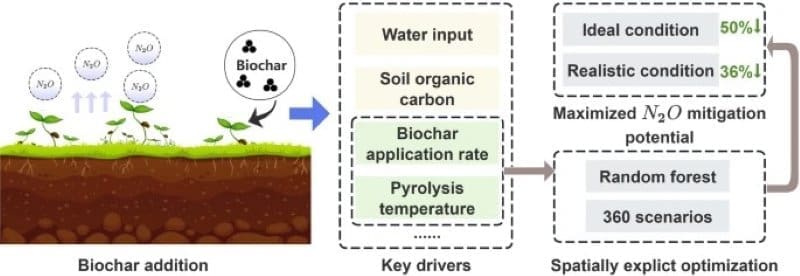
A study published in Biochar shows that straw-derived biochar, when applied using region-specific strategies, could reduce nitrous oxide emissions from China’s croplands by as much as 50 percent.
Nitrous oxide is primarily released from soils treated with nitrogen fertilizers. While biochar, a carbon-rich material produced by heating crop residues under low oxygen conditions, has long been recognized for its ability to store carbon in soils, its potential to reduce nitrous oxide emissions has been difficult to quantify at large scales. Previous estimates often relied on a single average value, overlooking how climate, soil properties, farming practices, and biochar characteristics interact across different regions.
To address this gap, researchers compiled data from more than a decade of field studies across China and combined meta-analysis with machine learning techniques. They then conducted a nationwide, high-resolution analysis to identify where and how biochar could most effectively reduce nitrous oxide emissions.
“Our results show that biochar’s climate benefits depend strongly on how it is made and where it is used,” said corresponding author Qing Yang. “By tailoring application rates and production conditions to local soil and climate factors, biochar can deliver far greater emission reductions than previously estimated.”
Under ideal conditions, where sufficient crop straw is available to produce biochar, the study found that optimized biochar application could avoid about half of China’s cropland nitrous oxide emissions. Even under realistic conditions that account for limited straw resources, emissions could still be reduced by roughly one third over time.
The analysis revealed that nitrogen fertilizer use is the single most important factor determining biochar’s effectiveness. Biochar performed best in regions with moderate to high fertilizer inputs, where nitrous oxide emissions are highest. Soil organic carbon levels and water availability also played key roles, while biochar properties such as pH and carbon content were strongly influenced by production temperature.
“There is no one-size-fits-all solution,” said Yang. “In wetter regions, biochar produced at higher temperatures performs better, while in drier areas or where wheat and maize residues dominate, lower production temperatures can be more effective.”
The study mapped optimal biochar strategies across China, highlighting eastern and central provinces such as Jiangsu and Henan as particularly promising regions for large-scale deployment. These areas combine high baseline emissions with strong responses to biochar application, meaning that well-designed projects could deliver substantial climate benefits.
Beyond reducing greenhouse gas emissions, biochar may also support sustainable agriculture. The researchers estimate that optimized biochar use could significantly increase crop yields by improving soil structure and nutrient efficiency. This opens the door to reducing fertilizer use while maintaining or even boosting food production.
“Biochar offers a rare opportunity to address climate change and food security at the same time,” Yang said. “With proper planning, farmers could cut emissions, improve soils, and make better use of agricultural waste.”
The authors emphasize that future research should consider biochar’s effects on other greenhouse gases, such as methane and carbon dioxide, as well as long-term changes as biochar ages in soil. Still, the findings provide one of the most comprehensive assessments to date of biochar’s potential role in climate-smart agriculture.
As countries search for scalable and affordable climate solutions, the study suggests that smarter use of agricultural residues could play a meaningful role in reducing emissions from one of the most challenging sectors to decarbonize.
Journal Reference:
Wang, Q., Yao, D., Tang, X. et al., ‘Maximizing nitrous oxide mitigation potential of straw-derived biochar in China with optimal application strategies’, Biochar 8, 1 (2026). DOI: 10.1007/s42773-025-00544-1
Article Source:
Press Release/Material by Biochar Editorial Office | Shenyang Agricultural University
Featured image credit: Freepik (AI Gen.)